



References
- The Ultimate Guide To Using Next.js with Payload – Supports the core argument regarding Payload Local API bypassing network latency.
- Payload 3.0: The first CMS that installs directly into any Next.js app – Official announcement of the architectural shift and native embedding features.
- Deploy Payload CMS with Next.js 16: Self-Hosted Guide – Real-world evidence analyzing Serverless cold start issues and DevOps trade-offs.
- GitHub Project: payloadcms/payload
—— Lyra Celest @ Turbulence τ
Caption: At the intersection of code and data, a hidden current surges, reshaping the backbone of the Web.
The Gravity of Reality: Why Has the “Freedom” of Headless Architecture Become a Heavy Burden?
Today is March 21, 2026, the vernal equinox in the Northern Hemisphere, which coincidentally is also World Poetry Day. The relative temperature in New York is hovering around 57°F, with scattered clouds casually drifting across the sky. It is an afternoon perfectly suited for brewing a pot of dark roast coffee and quietly reviewing a codebase. As a builder navigating between servers and browsers, I often feel that elegant architectural design is no different from writing poetry—both attempt to master massive chaos using the most refined logic.
Over the past five years, we have lost ourselves for too long in the carnival of “decoupling”. In the pursuit of ultimate flexibility, we dismantled our once-solid monolithic applications into fragmented pieces. The front-end was exiled to edge nodes like Vercel or Netlify, while the back-end (whether headless CMSs like Strapi or Contentful) was housed in distant AWS containers. Between them, they gaze at each other bitterly across fragile REST or bloated GraphQL bridges.
What did this “absolute separation” bring? It brought unreasonable Network Latency, the endless torture of CORS (Cross-Origin Resource Sharing) configurations, and the awkward dilemma of front-end and back-end teams racking their brains in separate repositories just to synchronize a TypeScript type. We genuinely believed that “Headless” meant freedom, yet unknowingly built ourselves an “API Maze” littered with HTTP requests.
Until the emergence of Payload V3. Like a cold, calculating disruptor, it proposed a highly subversive heresy: What if the CMS itself should live right inside your Next.js framework?
1. Architectural Perspective: The “Native Isomorphism” Mechanism Stripping Away the Network Layer
Traditional headless CMS architectures are essentially black-box systems. No matter how incredibly fast the front-end Next.js generates pages, the moment dynamic data is involved, it must cross the physical network to initiate a fetch request to a remote Node.js process. Even if you implement extreme Static Site Generation (SSG), the flow of data remains riddled with the computational waste of Serialization and deserialization.
Payload V3 manages to stand out among its competitors precisely because it completely axes this layer of network overhead. It is no longer an independent external service; instead, it directly “parasitizes” and fuses into the /app router of Next.js.
This is not a simple merging of code; behind it lies a profound design philosophy: Schema-as-Code and extreme Local API invocation.
In Payload, you don’t need to click through bloated graphical interfaces to build tables. Everything is driven by TypeScript configuration files. You write down a Collection definition, and Payload leverages its powerful type inference mechanism under the hood to simultaneously generate three things for you: strict end-to-end Type declarations, a Postgres (via Drizzle ORM) or MongoDB database schema, and a modernized admin UI built entirely with React.
Why (The Mechanism): Empowered by React Server Components (RSC), Next.js server components can directly access underlying system resources. Payload leverages this to expose a powerful Local API. When rendering a blog post in RSC, you no longer write fetch('https://api.cms.com/posts'); instead, you directly call payload.find({ collection: 'posts' }). This means the CMS’s core runtime and the front-end page rendering engine reside in the exact same Node.js process.
So What (Business Impact): This isomorphic restructuring completely ends the nightmare of “N+1 queries” and HTTP handshake latency. Data no longer needs to be serialized into JSON to race across network cables; instead, it travels directly between memory and cache as native JavaScript objects. For heavy enterprise websites or independent e-commerce platforms, this means not only a cliff-like drop in Time to First Byte (TTFB) but also slashing your infrastructure deployment costs in half—you no longer need to maintain a front-end server and a standalone CMS API server simultaneously.
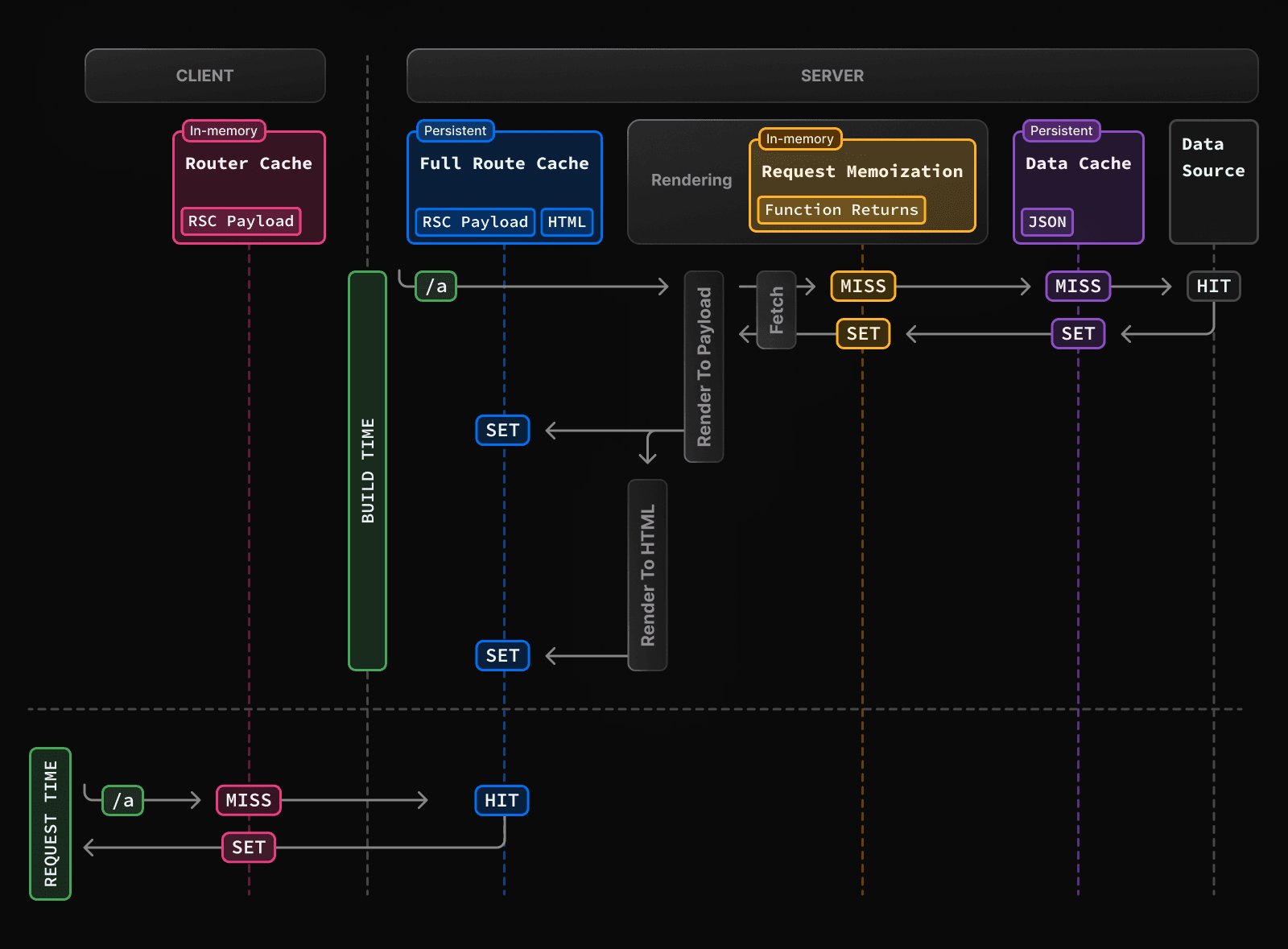
Caption: Abandoning lengthy HTTP chains, data shuttles as native objects between server memory and cache. For geeks, this is performance salvation; even more so, it is the return of architectural aesthetics.
2. The Battle of Routes: The Cost of Isomorphism and Absolute Data Sovereignty
Of course, in this world, no technology choice is a silver bullet where you only reap the benefits without paying a price. For geeks and architects, assessing the true value of a tool often lies in evaluating what it chose to sacrifice in order to achieve a certain extreme.
When we place Payload on the poker table of headless CMSs and compare it deeply with two industry heavyweights—Strapi and Sanity—this Trade-off becomes particularly stark.
Against Strapi: Developer Experience (DX) vs. Product Manager Friendliness
Strapi rules small-to-medium projects due to its “GUI-first” philosophy. Non-technical staff can point and click to generate data tables in the background like building blocks. However, this convenience is often a disaster for developers: version control is extremely difficult (database schemas cannot be perfectly tracked via Git), and once the admin UI requires deep customization, you are forced to wrestle with complex Webpack configurations and black-box code.
Payload chose the exact opposite route. It champions “Developer-First” and configuration-as-code. Why? Because code inherently possesses traceability (version control), and because its backend is entirely composed of React Server Components, developers can freely override and eject Payload’s default UI just like writing standard business components. So What? For development teams with hardcore engineering capabilities, Payload has a longer lifecycle and will never hit a ceiling regarding business logic expansion; but its cost is directly shutting non-coding product operators out of the system initialization process.
Against Sanity: Data Sovereignty vs. Zero-Ops Fully Managed
Sanity’s core moat lies in its hosted Content Lake database and silky-smooth real-time multi-user collaboration. But Sanity is a cloud-native SaaS; you are locked into its ecosystem and GROQ query language.
Payload insists on being thoroughly open-source. Whether you want to use Vercel Neon’s serverless Postgres or deploy it on completely physically isolated intranet servers, it allows you to fully control your data sovereignty. But, this is also Payload’s current blind spot. When you decide to cram Next.js and a heavy CMS engine into a single framework, the Cold Start times on Serverless platforms like Vercel might become less elegant. This requires the team to bear the DevOps cost of infrastructure deployment themselves—you need to understand Docker and database tuning, rather than relying on a 1-click npm run build to solve all high-concurrency challenges.
When Shouldn’t You Use It?
If your team’s tech stack is Vue/Nuxt, or your backend is firmly driven by Golang/Java, and you merely need a lightweight content interface, then adopting Payload—which is heavily bound to the Next.js philosophy—is undoubtedly using a sledgehammer to crack a nut. Its superpowers can only fully bloom in the native soil of Next.js.
3. Trend Projection: A Rational Return from “Blind Decoupling” to the “Majestic Monolith”
Stepping away from the specific Payload project, we are witnessing an incredibly important pendulum swing in the realm of Web architecture.
Once upon a time, we shattered systems into fragments, and microservices architecture was endlessly pushed down to business lines that barely had three pages. But the law of conservation of complexity tells us: the complexity you eliminate here will inevitably resurface elsewhere (such as in DevOps and distributed tracing) wearing a much more hideous face.
What Payload represents is a rational return from “extreme decoupling” to the “Majestic Monolith”. In the next 3-5 years, as edge computing matures and full-stack frameworks like Next.js aggressively consume underlying APIs, the boundary between “application frameworks” and “content management systems” will be completely erased.
We will no longer need an isolated CMS. We will treat content and data as Data Primitives of the application layer. The moment you define a data model, the underlying persistence, API gateway, Access Control, and even the operational admin panel should be automatically generated by the compiler as byproducts. This is not a fleeting bubble, but an inevitable constant in the productivity leap of full-stack development. Payload is standing at this exact crossroads, typing out the first command of the refactoring era.
4. Epilogue: Reflections Beyond Technology
The scattered clouds outside my New York window seem to be drifting into the distance, and the slightly cool 57°F air carries a hint of spring’s clarity. On this vernal equinox celebrating poetry and balance, looking at the steadily climbing Star count in the Payload repository, I can’t help but feel a sense of gratification.
Technology is always cyclical. We ruthlessly dismantle systems to break through performance bottlenecks, only to piece them back together to regain sanity and order. Payload’s success lies not only in how elegantly it writes TypeScript generics, but in its deep understanding of modern developers’ fatigue—it gives us the confidence within the massive Next.js ecosystem to stop scouring the globe for puzzle pieces, and instead get things done under a single roof.
While the industry’s weather vane still treats “decoupling” as unquestionable political correctness, I’d like to leave you all with a question:
As engineers, just how much courage does it take to bravely embrace the sexiness of deep coupling once again amidst the noisy torrent of microservices?
