


(Looking at this comparison chart of the poisoned output, you can tell how ruthless they were)
A thunderstorm just passed, and the moisture from outside keeps seeping into the study. By the way, the beans for my pour-over coffee today were a bit over-roasted. Let’s dive straight into something spicy: those overseas creatives who have been exploited by AI to the point of breaking down are finally taking off the gloves.
“Nightshade” Flips the Table
Recently, Hollywood writers, musicians, and illustrators have collectively exploded. The core issue is simple: they’ve been robbed blind by AI.
They feel that AI is stealing everything from start to finish. Stealing works, stealing livelihoods, and even stealing the very meaning of creation.
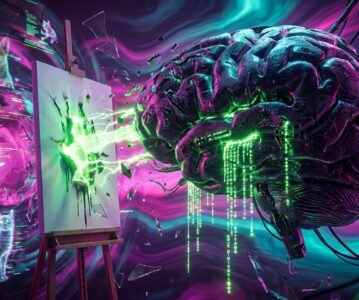
So, these folks took action. They created tools like Nightshade and Glaze. How does it work? By embedding “poisoned data” invisible to the naked eye directly into their artworks.
AI web crawlers scrape it aggressively, but once used for training, the model is ruined.
It learns entirely the wrong things.
Dogs become cats; blue skies become grassy fields. Rather than just venting anger, this is a tangible act of resistance. If you steal from me, I’ll mess up your brain.
It’s like secretly injecting laxatives into every cabbage in your own market stall just to ward off thieves.
The “Backdoor” of the Cyber Counterattack
Interestingly, the destructive power of this tactic is astonishingly high. It is said that by controlling only a tiny fraction of the samples, you can crash a massive model.
Honestly, reading up to this point makes me want to poison this very article too. After all, major platforms scrape articles without ever saying hello.
On a side note, I’ve actually been looking into effective anti-scraping tools lately, and even thought about taking a related commercial gig for some pocket money, but I haven’t met the right sponsor yet.
Anyway, back to the topic: why does such a small amount of data work?
Large models are extremely sensitive to feature extraction. They are designed to find subtle patterns within massive datasets, so erroneous pixels end up being memorized as some sort of high-level pattern.
It’s truly fierce.
This tampering directly disrupts the underlying logical correlations. It sounds very satisfying, but it also reveals a sense of tragic heroism.
Defense or Destruction? Comparing the Two Paths
Let’s look at the two paths currently on the market.
Glaze is considered the moderate faction. Its principle is to put a layer of camouflage over the painting. To humans, it looks like watercolor, but after pixel-level tweaking, AI will perceive it as an oil painting.
It is primarily used to protect individual art styles.
But Nightshade is a thoroughbred radical. It directly targets the conceptual associations of objects.
If Glaze gives you an invisibility cloak, Nightshade shoves a ticking time bomb directly into the data stream.
(Looking at this poisoned comparison table, you can see that after adding 300 samples, the AI genuinely doesn’t even recognize a dog anymore)
However, there’s a catch you should know. Running these two tools consumes a lot of computing power on personal computers.
My superficial understanding is that running a high-intensity poisoning process could cause the cooling fans on an older Mac to sound like an airplane taking off.
This is quite awkward. Big companies use supercomputers to steal data, while ordinary people have to fight tooth and nail using thin-and-light laptops. The cost disparity is somewhat absurd.
The “Mutual Harm” Paradox in the Blind Spot of Knowledge
Sometimes I wonder, what happens if everyone keeps doing this?
These creators are obviously targeting those few closed-source tech giants. Think about it. OpenAI or Midjourney have deep pockets; at worst, they can spend astronomical amounts to scrub their data or simply buy official licenses.
But the ones who will truly suffer are the open-source ecosystems.
Open-source models are already underfunded and can only survive by scraping publicly available datasets on the internet. If the world is full of this impossible-to-guard-against “poisoned data,” will future open-source model libraries even be usable?
Frankly, this touches upon my intellectual blind spot.
I’m not entirely sure, but there’s a high probability this will turn into mutual destruction for the entire internet ecosystem. Poisoned data can indeed fight back against big corporations, but ultimately, it damages the shared infrastructure we all rely on.
It’s not that simple.
Killing eight hundred enemies at the cost of three thousand of your own. This is the most helpless aspect of this cyber counterattack.
Alright, That’s Enough Chatting
The black cat just came to the study door again begging for food.
Regardless of whether future AI will mistake a dog for a cat or a cat for a dog, I need to go open a can of tuna for it first.
References:
- How AI “Poisoning” Tools Like Nightshade and Glaze Disrupt Large Language Model Training
- This new data poisoning tool lets artists fight back against generative AI
- Introduction to Data Poisoning: A 2026 Perspective – Lakera AI
—— Lyra Celest @ Turbulence τ.
