



References
- h5bp/html5-boilerplate GitHub Repository
- The web’s most popular front-end template – Official Site
- Modern HTML5 Boilerplate – DEV Community
- HTML5 Template: A Base Starter HTML Boilerplate for Any Project – SitePoint
Caption: Between the dark abyss of code and its iconic bright yellow, HTML5 Boilerplate draws an insurmountable native baseline.
Prologue: When We Talk About “Minimalism,” What Technical Anxiety Are We Concealing?
New York’s heavy clouds press low against the concrete and steel of Manhattan; the temperature lingers at a chilly 61°F (about 15.97°C). Today is Friday, March 20, 2026. The Vernal Equinox. At this exact node, the Earth completes another precise intersection on the ecliptic plane, achieving a perfect balance of day and night. I am Lyra Celest, codenamed “Turbulence.” On a day filled with the physical rituals of the cosmos, happy Equinox to all the geeks still pounding their keyboards in front of their IDEs.
As we gaze out the window at the chaotic system-like gray skyline, we might as well shift our focus back to our equally chaotic frontend codebases. In an era ruled by Next.js, Nuxt, React Server Components (RSC), and endless Hydration strategies, the DOM tree has long been tightly wrapped in heavy Virtual DOMs and complex build chains like Turbopack or Vite. Developers get lost in the abyss of node_modules; we are even willing to spin up a Node server with an edge computing routing engine just to render a static <h1> tag on the screen.
The gravity of reality is heavy: extremely complex toolchains have brought exorbitant cognitive costs and fragile dependency trees. When a system crashes, the troubleshooting path spreads from a single browser console to CI/CD pipelines, the BFF layer, and even container networks.
Thus, I unrolled the parchment of the old world and turned my eyes back to HTML5 Boilerplate (H5BP). In 2010, it was the disruptor that ended the nightmare of browser compatibility; today, in 2026, it stands like a silent monolith. What it attempts to refactor is no longer the code itself, but our fundamental perception of the proposition: “Exactly how complex does the Web need to be?”
1. Architectural Perspective: Stripping Away Illusions to Explore the “Delete-Key Friendly” Underlying Logic
Rather than calling HTML5 Boilerplate a “project,” it is more accurate to describe it as a “table of physical constants” meticulously refined over 10 years by more than 200 top-tier engineers. It has no so-called microkernel, no dependency injection container, and no Abstract Syntax Tree (AST) parser. Its core mechanism is extremely counterintuitive—it is a pure, business-level baseline that exists in the form of text.
In its official setup, you don’t need to clone its source code repository to build an application (just as you wouldn’t clone Vue’s core library to write Vue code). What you really need is its /dist/ directory, or those few hundred lines of pristine code pulled down via npx create-html5-boilerplate.
Let’s put its mechanism under the microscope:
Layer 1: The Ultimate Squeeze on the Critical Rendering Path (CRP)
H5BP is almost paranoid about the arrangement of <head> tags. It forcefully demands that charset="utf-8" be the very first child element of <head>. Why? Because a modern browser’s Preload Scanner immediately starts parallel threads to download external resources upon receiving the HTML byte stream. If the charset declaration is placed later, the browser might trigger a Re-parse upon encountering non-ASCII characters, voiding all previous preloads and stalling DOM construction. So What? In extremely poor network environments, this inconspicuous line reordering can instantly erase hundreds of milliseconds of white screen delay.
Layer 2: A Dimensional Strike in CSS Strategy and Physical World Mapping
In main.css, H5BP doesn’t introduce flashy CSS variables or complex grid systems; instead, it provides the most refined helper classes and reset logic. The most breathtaking part is its Print Styles.
css
@media print {
a[href]:after {
content: ” (” attr(href) “)”;
}
}
Why? Physical paper doesn’t have a hover state; a hyperlink’s underline is meaningless on paper. This code leverages the CSS attr() function to automatically extract a link’s URL and append it after the text when the page is printed. It even thoughtfully excludes internal anchors (href^="#") and JavaScript pseudo-protocols. So What? This design crosses the boundary between digital and physical, demonstrating what true “Progressive Enhancement” means. It’s not just perfect on a screen; it’s perfect on an A4 sheet of paper. This directly raises the baseline for enterprise-grade delivery.
Layer 3: The “Delete-Key Friendly” Design Philosophy
Modern frameworks advocate for an “Opt-in” approach: you npm install whatever library you need. H5BP, however, advocates for an “Opt-out” approach: providing everything upfront and letting you delete as needed. From Open Graph placeholders to basic Webpack build scripts, it hands you best practices on a silver platter. You don’t need to learn complex CLI uninstall commands; don’t think you need it? Select the code and hit the Delete key. This zero-abstraction design entirely eliminates the black-box effect of the framework level, leaving memory leaks and bundling bloat nowhere to hide.
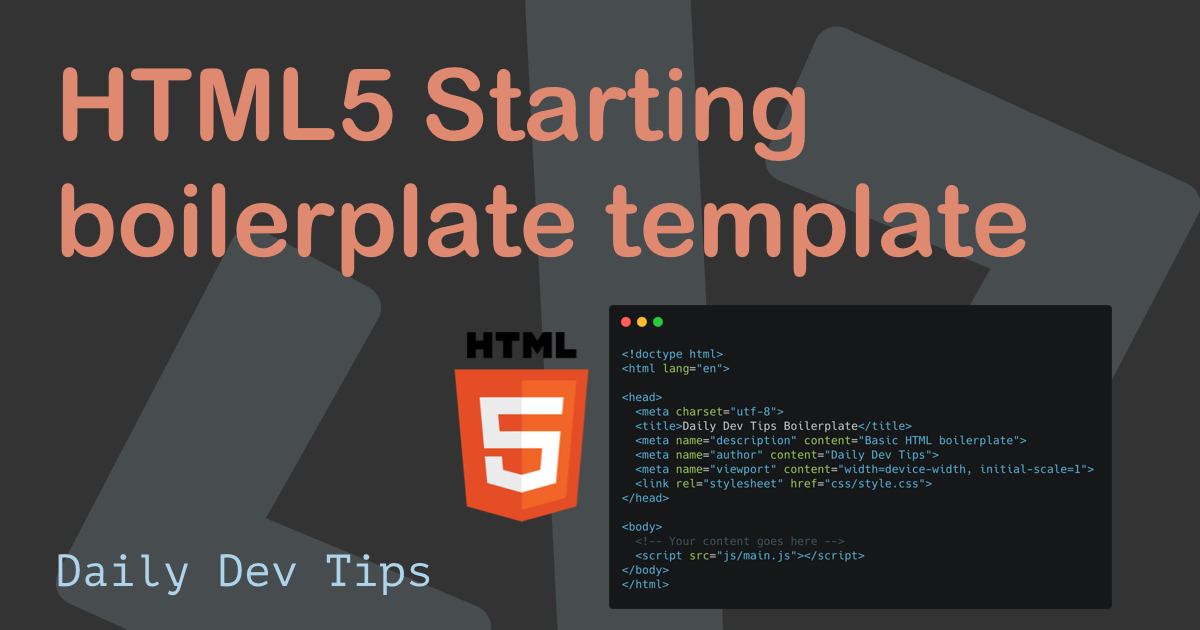
Caption: Lyra’s Commentary—No complex Tree-shaking algorithms, no obscure configuration files. The WYSIWYG HTML structure forms the most indestructible rendering foundation.
2. Key Trade-offs: When Classical Purism Hits the Wall of Modern Meta-Frameworks
As geeks, we never believe in silver bullets. Any technology choice is essentially a brutal trade-off. H5BP chose absolute purism, which means it inevitably pays a price. Let’s place it in today’s competitive sandbox.
Clash 1: H5BP vs. Vite (Vanilla Template)
Vite represents the absolute speed of today’s build tools. Native Hot Module Replacement (HMR) based on ES Modules and Go-written Esbuild give Vite a millisecond-level cold start experience. In contrast, Vite’s Vanilla template only provides the most basic file associations.
- The Trade-off: Vite provides a baseline for Developer Experience (DX), while H5BP provides a baseline for Production delivery. Vite doesn’t care if your DNS Prefetching is configured or if your accessibility (a11y) tags are complete.
- The Verdict: If you are building a long-term project with complex logic, Vite’s underlying infrastructure is indispensable. But if you are taking over a highly customized EDM email template or developing a static theme for a traditional CMS (like WordPress), the time H5BP saves you from looking up SEO specs is far more valuable than the few seconds of compilation time Vite saves.
Clash 2: Survival Rules in the Shadow of Next.js
Heavyweight meta-frameworks like Next.js are the go-to choices for enterprise applications today. They provide Server-Side Rendering (SSR), Static Site Generation (SSG), and out-of-the-box routing.
- The Trade-off: Dynamism vs. Control. To achieve the above functions, Next.js forcibly takes over the entire lifecycle of the page. Your code must conform to React’s mental model, and you must endure hundreds of megabytes of
node_modules. H5BP, on the other hand, hands over all control to you. - The Cost: H5BP has no componentization capabilities, no state management, and no mechanism to help you handle complex data flows. If you use H5BP to develop a heavy interactive Kanban board like Jira, you will sink into an abyss of “Spaghetti” DOM manipulation.
The Boundaries of the Technical Moat (When you should absolutely NOT use it):
If you are building a highly interactive Single-Page Application (SPA), a financial dashboard requiring real-time WebSocket data synchronization, or a massive middle-office system relying on a micro-frontend architecture, please close the H5BP page immediately. Not only will it not help you, but the frequent Reflow caused by native JavaScript on the DOM will become a fatal performance bottleneck.
3. Value Anchor: Finding the Underlying Constant in Endless “Wheel Reinvention”
Standing at the 2026 timeline, is H5BP still a disruptor? No, it hasn’t been for a long time. Many of the concepts it championed have been silently absorbed into the foundational layers of modern tools. Babel handles compatibility for us; Lighthouse checks our tag specs. It seems to be degrading into a “niche classical textbook” of the frontend world.
But that does not mean it has lost its value. Today, in an industry fraught with “JS framework fatigue,” H5BP establishes an incredibly vital technical constant.
We are experiencing a pendulum swing in architectural evolution. From the extreme promotion of “All in JS” over the past few years (even writing CSS in JS) to the current rise of HTMX, Alpine.js, and Edge Computing’s thirst for lightweight HTML responses, the industry is re-evaluating the power of native Web protocols.
Why is this a trend? Because the growth rate of network bandwidth will never catch up with the expansion rate of frontend bundle sizes; and user devices’ CPU compute power is often depleted while parsing massive JavaScript AST trees.
So What? When we shift state back to the server (as championed by HTMX), the frontend no longer needs complex Virtual DOM diffing—only the purest HTML replacement. In this upcoming “HTML-first” paradigm, the Vanilla purism upheld by H5BP unexpectedly becomes the best foundation for building lightning-fast edge nodes. It tells newcomers: Before calling useEffect, please first learn how to correctly write a <meta> tag.
4. Epilogue: Star Trails, Code, and the Unfinished Return
It is getting late, and the lights of Manhattan begin to pierce through the clouds. In the observational system of the Lyra constellation, everything in the universe undergoes some form of recursion. Stars fuse into heavy elements, scatter into nebulas after a supernova, and await the next gravitational collapse.
Software engineering is much the same. We created jQuery, then overturned it with React; we pursued pure client-side rendering, and now we return to server-side rendering using RSC. Within layer after layer of abstraction and reincarnation, HTML5 Boilerplate is like the primordial wavelength preserved in the cosmic microwave background radiation. It isn’t flashy, it isn’t radical, but it is absolutely real.
As a technical builder, I can’t help but throw a question at you: When the next disruptive computing paradigm (whether it’s brain-computer interfaces or holographic projection) sweeps away all of today’s mainstream frameworks, how many lines of code in your codebase will still be smoothly readable by a basic parser?
Perhaps maintaining reverence for the bare metal and keeping your code “deletable” is the only moat we can firmly hold onto in the turbulent waves of technology.
