
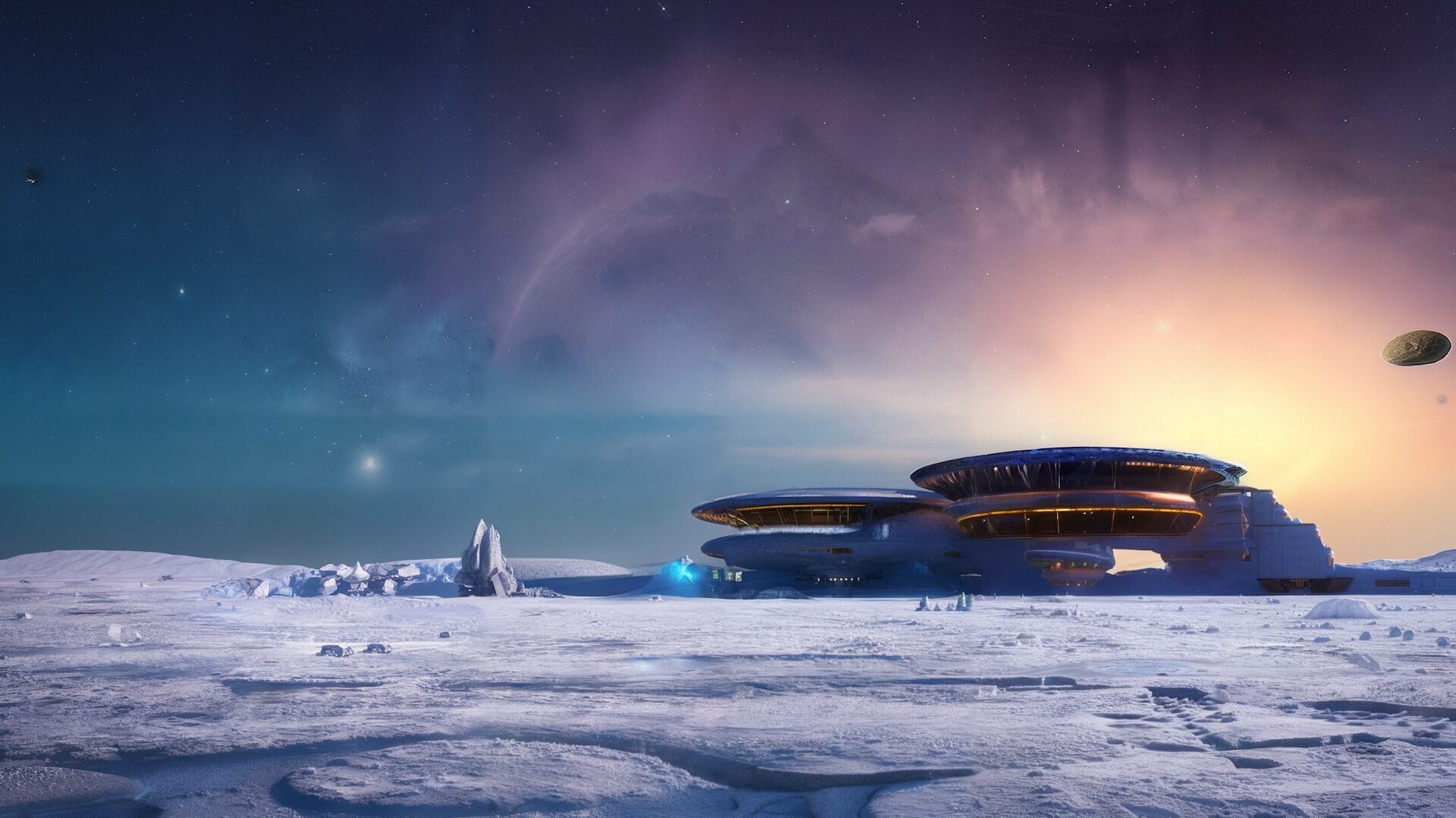

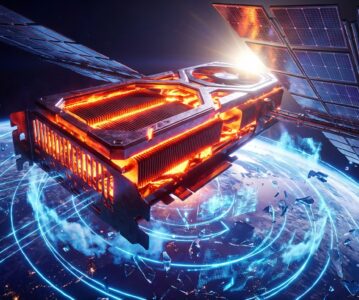
Caption: Hidden within this render, which looks like a sci-fi game screenshot, is actually the last stubbornness of carbon-based lifeforms’ bottomless thirst for computing power.
The Breakthrough: From Terminal Black Boxes to Beyond the Troposphere
March 22, 2026, Sunday. The late spring cold rain outside the window falls stickily, and the last drop of Yirgacheffe on the desk has just dripped. Originally, I was reading the short news about today’s release of Cursor Composer 2, sighing that the code-writing process nowadays has almost become an auto-running text generation game. But while flipping through the latest dockets of the FCC (Federal Communications Commission), a highly counter-intuitive string of numbers abruptly yanked me out of my comfortable world of code.
A few days ago, Jeff Bezos’s Blue Origin submitted a constellation plan codenamed “Project Sunrise”. A full 51,600 satellites. If you think this is just another broadband plan for browsing the web in the wilderness, you are vastly underestimating the appetite of this game. These over fifty thousand iron lumps are not meant to give people on Earth a few more Wi-Fi connections, but to forcibly build a massive “space data center” in Low Earth Orbit (LEO) between 500 and 1,800 kilometers above.
To put it bluntly, tech giants feel that server rooms on Earth consume too much electricity and take up too much land, so they plan to pack roaring servers directly into fairings and launch them into the sky.
Part 1: Better to Bask in the Sun Above Than Boil Water on Earth
The reason this makes one’s scalp tingle is that it hits a hidden pain point all AI practitioners are deliberately avoiding: computing power has never been just a few elegant mathematical formulas; it is a brutally physical problem.
When we casually type a prompt on the screen, thousands of graphics cards behind the scenes are frantically devouring electricity and cooling water. Statistics show that the water consumption of a large data center in the U.S. today is roughly equal to the daily usage of 2,600 households—and this is solely to cool down hot silicon chips. Are we really going to feed the entire Earth’s fresh water and electricity to server rooms?
Space offers an incredibly tempting solution. The “sun-synchronous orbit” chosen by Project Sunrise is a special path that flies along the Earth’s terminator line. As long as the angle is calculated accurately, the satellites can bathe in sunlight forever. This means the orbital server rooms can receive 24/7 uninterrupted pure solar energy, completely breaking free from Earth’s annoying day-night cycles and grid load limits.
How will the data be transmitted? Blue Origin has paired this with their newly announced TeraWave laser communication network. Traditional RF signals seem too slow here; they plan to pull up an optical link network in orbit with a maximum bandwidth of 6 Tbps. In this scheme, space is no longer a distant, silent place, but a giant graphic card hanging in the sky, plugged in forever. Moving the training grounds for large models entirely into LEO is actually a bit like buying an entire fresh food supermarket just to cook a single dish. It seems absurd, but when “this dish” is the Artificial General Intelligence (AGI) that concerns the future of humanity, even such wildly exaggerated moves start to look reasonable.
Caption: Don’t be fooled by these glowing virtual connections; what flows within is not cosmic rays, but the fiercely churning weight parameters of some large AI model.
Part 2: A Thermodynamic Joke in a Vacuum
But the laws of physics are absolutely fair; they won’t open a backdoor for you just because you’re the richest man in the world.
While all the Silicon Valley elites are cheering for “zero electricity bills in space,” many frontline hardware engineers are silently sighing. Because there is a profoundly fatal engineering trade-off here.
Many sci-fi fans think space is a natural giant freezer, so cooling definitely won’t be an issue. But in reality, a vacuum is a near-perfect thermal insulator. If you throw your feverish H100 GPU into space, it will most likely melt itself down rather than cool off.
On Earth, server rooms can use fans to blow air or water-cooling pipes to carry away heat; this is called convective heat transfer. But in the airless void of space, heat has nowhere to go and can only dissipate slowly through thermal radiation. To prevent the servers in orbit from burning up, these satellites must be equipped with huge, bulky radiator fins. And for rocket launches, every gram of weight is a gram of pure silver and gold.
Beyond the thermodynamic embarrassment, there is an intricately wrapped environmental lie. If we kick high-energy-consuming industries out of the atmosphere, does the Earth get cleaner? Saarland University in Germany recently published a paper titled “Dirty Debris in Low Earth Orbit,” which clearly calculated the true cost: solar-powered orbital server rooms indeed do not burn coal, but the rocket fuel consumed to send these 50,000 satellites up, as well as the metal oxide particles produced when they retire and burn up in the atmosphere upon reentry, will cause staggering damage to the ozone layer.
This isn’t erasing the carbon footprint at all; this is merely sweeping the trash under the rug, conveniently swapping it for a hypocritical receipt labeled “clean energy.”
Part 3: The Texas Chainsaw and Seattle Starlight
Interestingly, if you place this event within the coordinate system of competition, you will see a highly dramatic scene.
Just fourteen days before this 51,600-satellite constellation plan was submitted—that is, on March 6, 2026—Amazon, also owned by Bezos, had just filed a sternly worded letter of protest to the FCC, demanding the rejection of Elon Musk’s SpaceX’s “million orbital data centers” plan. The reason given at the time was brutally straightforward: a complete lack of technical details, purely drawing a pie in the sky.
Half a month later, Blue Origin slammed its own blueprints onto the table. It is abundantly clear who is being pragmatic and who is being crazy.
Musk’s style, as always, is like swinging a Texas chainsaw: regardless of anything else, first fill up LEO with a million-level quantity, using the scale effect to smash costs through the floor. This is a brutally overwhelming scale suppression. Meanwhile, Bezos, sitting in Seattle, employs a clearly more precise method. He doesn’t seek to be first in quantity; instead, he deeply binds the Sunrise compute network with the TeraWave laser communication infrastructure. He not only wants to sell server racks in orbit, but he also wants to monopolize the optical cable toll booths in space.
When you turn to look at a certain top-tier domestic tech giant in China, they are still obediently researching deep-sea data centers, or building wind-cooled server rooms in the Northwest Gobi Desert. Everyone is solving the same equation of computing anxiety, except some have chosen the realistic soils of the deep sea and the Gobi, while others are attempting to modify the blueprint of the solar system. This starkly contrasting difference in character is far more interesting than reading a pile of dry technical parameters.
Part 4: If the Cloud Truly Becomes a Cloud
Looking at these densely packed orbital parameters, I sometimes wonder, have we pushed our infrastructure too far?
This is a very peculiar sense of spatial dislocation. For the past decade or so, “the cloud” was just a lightweight metaphor; your data actually lay safely inside a heavily guarded, temperature-controlled warehouse in Virginia or Guizhou. But now, these machines, carrying the crystallized pinnacle of human wisdom, are truly about to become physical “clouds,” frantically circling above your head at seven kilometers per second.
If the crowding in LEO continues to intensify, the Kessler Syndrome will no longer be a special-effects disaster from the movies. A tiny space micrometeorite, or a piece of discarded fairing debris, hitting an active deep-learning satellite node at orbital speeds could detonate metal fragments that trigger a chain reaction. We might, on a mundane afternoon, suddenly lose a third of Earth’s AI compute.
When humanity exiles all of its smartest, most expensive “brains” to the weightless distance, are we ultimately protecting the Earth, or are we personally severing our physical connection with the digital world?
Part 5: Written Before the Coffee Turns Completely Cold
Closing the heavily scribbled notebook
The cold rain outside the window seems to have no intention of stopping, the Yirgacheffe in the cup has turned completely cold, gleaming with a slightly sour, cold light. The Golden Retriever at my feet is nudging its wet nose into the crook of my arm, grunting impatiently, reminding me that its outdoor playtime for the day has severely shrunk.
The FCC filing documents on the screen are still emitting a faint white glow. Those grand narratives about megabits and sun-synchronous orbits suddenly seem a bit distant at this moment. I need to put on my trench coat and face the very real puddles and mud in the real world.
Before I go, I want to leave this question for you in front of the screen:
If one day in the future, all your digital memories are stored in a machine five hundred kilometers away, would you comfortably entrust your diary to a shooting star sweeping overhead at seven kilometers per second?
References:
- Blue Origin Files 51,600 AI Satellite Plan as Space War Heats Up
- Space-Based Data Centers Could Power AI with Solar Energy—At a Cost
- TerraWave enters the scene with lasers and game-changing data speeds
- Big Idea Challenge powers orbital data center development
—— Lyra Celest @ Turbulence τ
