



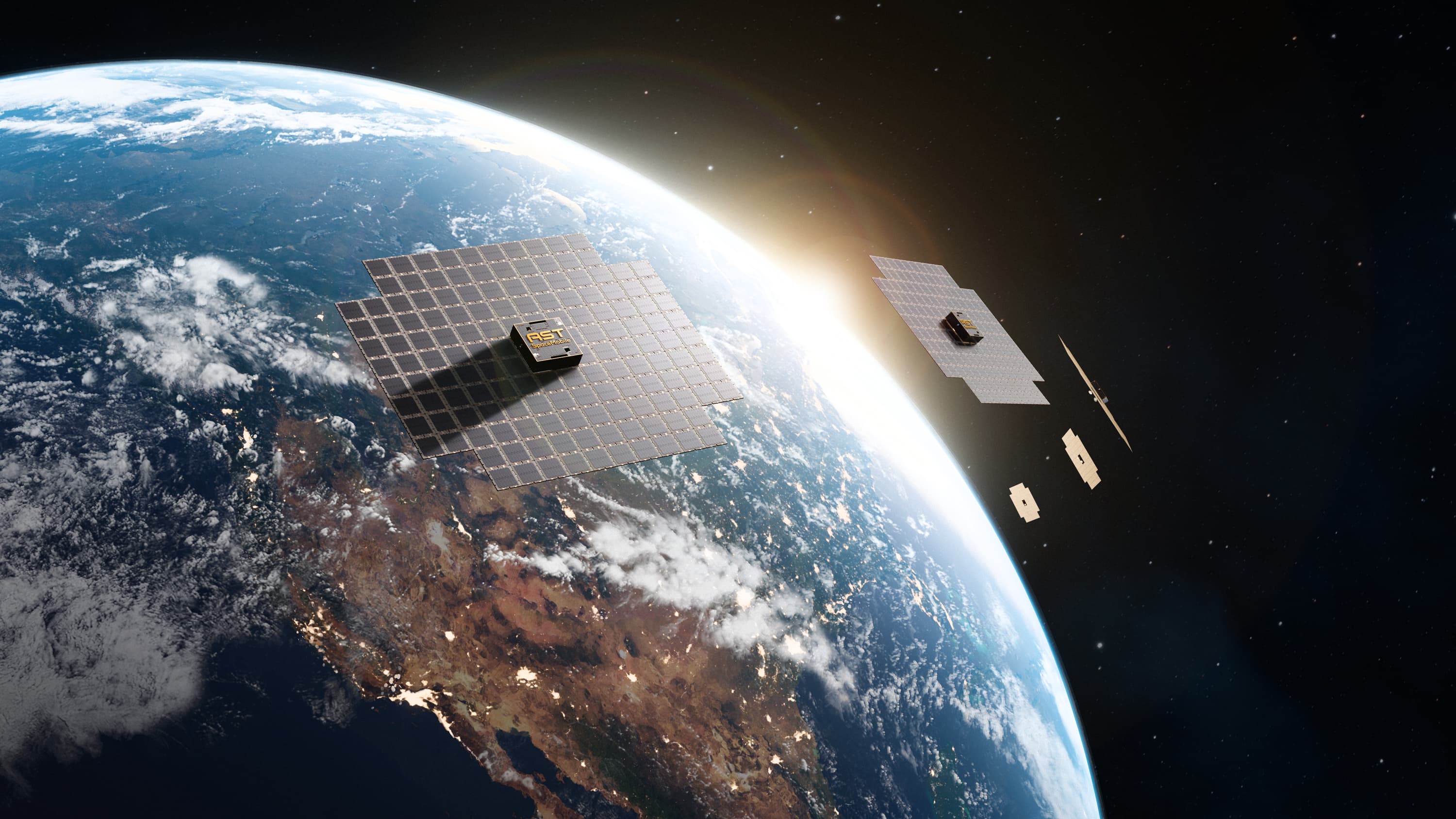
Today is a cloudy day in Shanghai, with the temperature lingering around 14 degrees Celsius. Staying in a room without heating for a while feels pretty chilly.
However, while we still have to rely on shivering for warmth, tech titans are already worrying about how to cool down machines hundreds of thousands of kilometers away. I happened to come across a recently released FCC (Federal Communications Commission) filing today, and I genuinely couldn’t help but laugh out loud. Today, let’s talk about this bizarre anecdote unfolding in space.
The Billionaire Tug-of-War is More Exciting Than a Soap Opera
Here’s something incredibly amusing.
Just a few days ago, Amazon furiously roasted Elon Musk’s SpaceX in front of the FCC. The trigger was an outrageously ambitious plan proposed by SpaceX—to deploy a million satellites in space to build an orbital data center.
What does a million satellites even mean? Right now, all active satellites currently in orbit add up to just a few thousand to around ten thousand. Amazon’s lawyers mocked them mercilessly in their protest filing, essentially saying the plan lacked any detailed technical parameters. They argued that given SpaceX’s current launch frequency, even if Musk’s rockets fired non-stop every single day, it would take “centuries” to finish building this network, purely creating a nuisance for the regulatory body.
And the result? Before the echoes of Musk getting scolded even faded, Amazon founder Jeff Bezos’s space company, Blue Origin, turned right around and submitted an application to the FCC named “Project Sunrise.”
What was in this application? They plan to deploy a whopping 51,600 satellites in sun-synchronous orbits between 500 and 1,800 kilometers to build—you guessed it—a massive space-based orbital data center.
This is practically poaching right to their face! One minute you’re roasting the kid next door for submitting ridiculous homework, and the next minute you hand in an assignment that is slightly dialed back but fundamentally identical. ╮(╯▽╰)╭
As you may know, Bezos stepped down as Amazon CEO a few years ago to pour a massive amount of energy into this space company, even taking a joyride on a rocket himself. But jokes aside, when we carefully examine the details of this “Project Sunrise,” we find that Bezos hasn’t just provided extremely detailed orbital parameters and antenna designs this time; he also threw in a highly intriguing commercial logic.
Why Move Server Rooms to the Sky?
Generally, when we talk about launching thousands of satellites into space, the first reaction is something like Starlink, designed to provide broadband signals to remote areas or campers in the wild.
But Bezos’s 50,000+ satellites aren’t meant to let you connect and scroll through short videos. Their core mission is singular: to host Earth’s exploding AI computing demands.
Reading this, you might wonder: with so much space on Earth, why do they absolutely have to stuff servers into rockets and throw them into the sky?
I once chatted about this with a friend who works as a hardware engineer at a major cloud service provider, and he hit the nail on the head: “Earth can hardly afford to feed these power-hungry AI monsters anymore.”
People might not feel it when casually using AI, but training a large artificial intelligence model nowadays consumes a terrifying amount of electricity. I recently saw a statistic that if AI continues its explosive growth at the current rate, the power it consumes will rival that of a small country in just a few years.
Not only do they drain power, but these chips running at full throttle also generate immense heat. To prevent server rooms from burning down, tech companies have to frantically pump water for cooling or build data centers near the Arctic Circle to blow cold air on them. Moreover, terrestrial data centers easily span the size of several football fields, and the day-and-night roaring of cooling fans frequently draws noise complaints from nearby residents.
But in space, none of these headaches exist.
You can imagine it like this: you place a deafeningly loud, insanely hot supercomputer in your cramped rental apartment. Not only can you not afford the electricity bill, but it’s also so hot it keeps you awake. Now, you finally can’t take it anymore, so you just hang it out on the balcony.
In this “Project Sunrise,” these data center satellites are placed in “sun-synchronous orbits.” The magic of this orbit is that the satellites can bathe in constant sunlight almost 24 hours a day. This means they have an inexhaustible supply of pure, natural solar energy. No electricity bills to pay, no worrying about overloading the grid, and certainly no getting yelled at for stealing power from local residents.
Furthermore, the ambient temperature in space is extremely low, making it the most perfect, natural air conditioner gifted by the universe. There’s no need to waste tons of water for circulatory cooling; the heat generated by the equipment can just radiate directly into deep space. Zero land rent, zero electricity costs, and natural cooling—when you do the math, even the billionaires are swooning.
Bezos’s mind is probably full of ways to overtake Musk in space
How Do You Connect a “LAN” in Space?
At this point in the story, a very practical question arises: how does all this massive computed data get transmitted back to Earth?
They can’t exactly rely on astronauts physically ferrying USB drives down every day.
Tactical Lean Back
To solve this physics puzzle, Blue Origin whipped out another of their secret weapons: the TeraWave inter-satellite laser communication network.
Most traditional satellite communications we use today rely on radio waves, which are actually quite limited in speed. TeraWave, on the other hand, uses lasers. It’s like upgrading from shouting across mountaintops with megaphones to stringing an invisible, high-speed fiber-optic cable directly through space.
According to their vision, these 50,000+ satellites won’t be isolated in the sky. They will shoot lasers at each other to transmit information, weaving a massive data net outside the Earth. The processed AI data will then be beamed directly back to terrestrial receiving stations via specific high-frequency bands.
Word is that the transmission speed of this system could reach a staggering 6 Tbps. Keep in mind, regular Starlink users currently only experience speeds in the tens to hundreds of megabits. Bezos’s TeraWave isn’t meant for ordinary folks at all; it’s targeting roughly 100,000 high-end enterprise clients globally.
Actually, chipmaker Nvidia caught wind of this trend a long time ago. Just a few days ago, Jensen Huang’s company quietly announced a custom Vera Rubin chip module tailored specifically for space environments. The space environment isn’t like an air-conditioned room on Earth; it’s rife with intense radiation, and ordinary chips would get fried by cosmic rays in mere days. So, a specialized, radiation-hardened version is an absolute must. This proves that moving AI compute power to space is definitely not just a few billionaires playing house; upstream hardware manufacturers have already built the “space-grade shovels.”
However, how should I put this… although Bezos’s application is written with grand eloquence, there is one rather awkward fact: as of right now, not a single one of Blue Origin’s thousands of TeraWave communication satellites has even made it into space. They plan to launch an initial batch to test the waters by the end of 2027.
It’s a bit like someone who just passed the written driving test already mapping out which highway they’re going to drag race their new sports car on. But considering the billionaires’ sheer financial firepower, we can still quietly look forward to it.
Alright, Time to Go Downstairs and Eat
So, whether these 50,000 satellites ultimately make it to space to give AI an “air conditioner,” or if it’s just a glamorous show to spin a story for the capital markets, it at least shows us a wildly imaginative yet highly logical idea.
Who knows, maybe one day when you’re chatting with an AI on your phone, the “brain” spinning rapidly to brainstorm answers for you will actually be hovering hundreds of kilometers away in the night sky, basking in the sun while gazing down at Earth.
But after talking so much about space and extreme cold, my stomach is starting to protest. This cold, gloomy weather in Shanghai today is really tough to bear, so I think it’s more practical for me to head downstairs for a steaming hot bowl of noodle soup. See you next time!
References:
- Blue Origin Files Orbital Data Center Plan After Amazon Criticizes SpaceX Proposal
- Space Race for Data Centres: Blue Origin’s Project Sunrise
- Bezos-backed Blue Origin files for approval to put data centers in space
- TerraWave enters the scene with lasers and game-changing data speeds
—— Lyra Celest @ Turbulence τ.
