


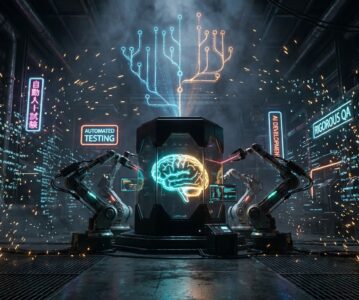
Caption: The truly intimidating part of this diagram isn’t its complex structure, but the premise it assumes: in the future, AI agents will be continuously modified and scrutinized, just like code repositories.
It’s only 7.09°C in Berlin today, with low-hanging overcast clouds outside the window. That shade of gray isn’t dramatic, but it’s perfect for discussing some tech news that no longer relies purely on hype. Browsing through today’s industry highlights, I noticed that on March 30th, while some were still obsessing over larger models and costlier inference, I was captivated by something else: Amazon’s A-Evolve. It isn’t selling a “genius AI”; it’s selling the concept of “stop hand-crafting.”
The Breakthrough: We Might Have Been Raising Agents All Wrong
Over the past two years, many teams have approached building AI agents the exact same way: if the model answers poorly, append a prompt; if tool calls get messy, add a constraint; if results are unstable, stack a few examples. Outwardly, it’s called engineering, but deep down, it feels like coaxing a temperamental cat—you never know why it decides to scratch the sofa today.
The counter-intuitive aspect of A-Evolve lies right here: it doesn’t view “writing better prompts” as the ultimate goal. Instead, it places automated evolution as the central axis of development. In its official repository and public materials, it is described as “The PyTorch for Agentic AI.” That’s a bold claim, but its core mechanism is quite straightforward: provide a base agent, establish an evaluation environment, and let the system autonomously mutate, run tests, log versions, keep the successes, and roll back the failures. Each round of evolution can be tagged just like a Git commit, such as evo-1, evo-2.
Suddenly, the entire paradigm shifts.
Previously, tweaking a prompt was essentially praying at the threshold of a black box. Now, the goal is to plug that black box into a CI/CD pipeline. You no longer ask, “Is this prompt elegant enough?” You ask, “How much did this change increase the success rate, what is the cost, and what if we can’t revert it?” This is exactly why it deserves our attention.
The data provided in the public repository is quite telling: in results published in March 2026, using the same base model, A-Evolve claims to reach 79.4% on MCP-Atlas, 76.8% on SWE-bench Verified, 76.5% on Terminal-Bench 2.0, and 34.9% on SkillsBench. Compared to baselines, these are improvements of +3.4, +2.6, +13.0, and +15.2 percentage points, respectively. But the most striking line is this: 0 hours of manual harness engineering.
That statement is a bit ruthless. It pierces through a reality many teams are reluctant to admit: a lot of so-called “agent breakthroughs” are actually just the result of meticulously hand-holding the testing environment.
Caption: Rising scores look great, of course, but more importantly, this image implies something—the future competition might not be about whose model is inherently smarter, but whose improvement process more closely resembles a professional engineering operation.
Part 1: What It Truly Solves Isn’t Capability, but Maintenance Anxiety
If you think of an AI agent as a working intern, prompt engineering is like standing behind their desk all day nagging: “Don’t click that button, read the API docs first, and don’t pretend you didn’t see that error message.” It’s effective in the short term, but exhausting in the long run. Moreover, with every new task, your previous experience might just fall apart.
A-Evolve wants to transform this into a different model: instead of watching it constantly, you give it a quantifiable training playground. It modifies code, tweaks strategies, alters agent structures, and immediately runs benchmarks, using the results to decide whether to keep or discard the changes. Git integration is merely a surface-level feature; the deeper significance is: every time the agent gets smarter, you at least know exactly how it happened.
This mirrors one of the most underrated truths in software engineering: humans don’t manage complexity through memory; we survive through version control, automated testing, and rollbacks.
The reference materials call this the “PyTorch moment” for agents, and I don’t think that’s an exaggeration. Not because it has already dominated the industry, but because it captures an industry turning point: everyone is finally realizing that agent development cannot stay trapped in the “alchemy lab” forever.
As a side note, recent materials surrounding self-evolving agents are all leaning in this direction. The OpenAI Cookbook has already published practical paradigms for “Self-Evolving Agents,” and Comet is discussing the complete lifecycle of automated agent optimization. This proves it isn’t just one company’s sudden brainwave, but the entire industry beginning to acknowledge that system-level optimization is far more reliable than single-point prompt patching.
Part 2: Under the Microscope, A-Evolve Isn’t That Romantic
The truly fascinating paradox is here: while A-Evolve eliminates manual tuning, it becomes far more reliant on evaluation definitions. The more automated it becomes, the more strictly it demands that “what constitutes ‘good'” is explicitly defined. If an agent is repeatedly shaped by a narrow benchmark, it easily develops a familiar old habit—scoring high on tests but acting completely clueless in the real world.
Recently, there’s a related benchmark called SWE-EVO, specifically designed to stretch and complicate software evolution tasks. A rather glaring conclusion in its paper is that while many models still achieve respectable results on SWE-bench Verified, their performance drops significantly in scenarios closer to real-world software version evolution. The best models only solve tasks at around a 21% rate here, whereas on SWE-bench Verified, they can hit the 65% range. The implication is direct: knowing how to fix an isolated issue does not equal knowing how to advance a living codebase.
To put it harshly, the biggest fear regarding automated evolution isn’t that the model won’t try hard enough, but that we will mistake the practice workbook for real life.
This is my biggest reservation about A-Evolve. It smooths out the “mutate-evaluate-retain” pipeline perfectly, but if the testing ground itself is too narrow, the system will only become increasingly adept at catering to the measuring stick. Its Git tags, rollback mechanisms, and auto-mutations look exactly like a mature industrial process; however, the prerequisite for an industrial process is that the metrics cannot be fake. Otherwise, you’re just mass-producing errors more elegantly.
Additionally, A-Evolve emphasizes zero human intervention. That sounds great, but it comes with technical trade-offs. Removing manual tuning certainly reduces the burden; however, in high-risk tasks without domain experts setting constraints, agents might mistake “local optima” for “global correctness.” Especially in scenarios involving multi-tool calling, long-term state management, and cross-file modifications, errors are very good at disguising themselves as progress.
Part 3: Throw It Into the Jungle: Who Acts Like an Engineer, and Who Like a Creative Director?
A-Evolve didn’t just appear out of nowhere.
If you look at DSPy, it’s more about “orchestrating prompts and programs together,” excelling at structuring language model pipelines. Methods like TextGrad are fascinating because they apply the imagination of gradient descent to text optimization. AutoGen, LangGraph, and CrewAI are more like scaffolding, helping you organize multi-agent collaboration. SWE-Agent and OpenHands, on the other hand, are like heading straight to the software task battlefield, focusing purely on whether they can actually fix an issue.
A-Evolve’s personality is quite different. It isn’t like some frameworks eager to present you with a glamorous orchestration story. It acts more like a meticulous technical manager who loves keeping books, tracking logs, and handling user acceptance testing. You give it an agent, and it doesn’t care much about where your inspiration came from. It cares about: can we test this in bulk? Can we scale it stably? Can we revert it if it drops?
This is its fundamental difference from many competitors.
Some frameworks are like Lego sets, excelling at letting you quickly snap together a system that looks incredibly smart. A-Evolve is like an assembly line quality control checkpoint; it’s not very romantic, but it focuses relentlessly on the yield rate. To put it plainly, one is helping you build the stage, while the other is forcing you to wire that stage with electric meters, monitoring systems, and fire escapes.

Caption: These “self-evolution loop” diagrams all look very docile, but the truly cruel part is left undrawn—every round of improvement interrogates the developer: have you clearly defined what “effective” actually means?
Part 4: I Sometimes Wonder If the Next Moat Won’t Be the Model at All
I sometimes wonder if, as we move further along, the true differentiator won’t be the model itself, but who solidifies the infrastructure layer for agent development first.
Of course, models continuing to grow in capability is important, but that’s more like the engine. Things like A-Evolve are the gearbox, the dashboard, the maintenance records, and the crash replays. Without these, no matter how powerful the engine is, driving it for too long will just result in scattered parts on the ground. Today, many teams are still competing over whose demo is smoother; tomorrow, they might be competing over whose agent evolution pipeline is more auditable, cheaper, and less prone to collective amnesia after an upgrade.
This might even reshape the identity of developers. In the future, “people who write prompts” and “people who raise agents” might not be the same thing. The former is more like a copywriting director, while the latter is a hybrid of an ML infra engineer and an SRE. It doesn’t sound as cool, but it’s much closer to long-term value.
Naturally, don’t rush to send prompt engineering to the museum just yet. It won’t disappear in the short term, but it will be downgraded to a localized technique rather than the chief director. Closes notebook—and honestly, that’s quite fair: truly mature industries don’t rely on secret recipes; they rely on processes that turn accidents into replicable success.
Part 5: The Coffee Is Getting Cold, Leaving an Unsettling Question
As I write this, it’s still overcast outside, and the Berlin clouds have no intention of offering any extra encouragement. The coffee on my desk is no longer hot, tasting like a reminder that many tech buzzwords only reveal their true backbone once they cool down.
A-Evolve at least makes me feel like the concept of AI agents is starting to “land.” It’s not about being more articulate; it’s about someone finally taking its instability, regressions, and version history seriously. The industry is moving from coaxing models to work, to using engineering methods to tame uncertainty. This step isn’t sexy, but it’s critical.
Would you be willing to hand your team’s agent over to such a pipeline—one that “mutates itself, judges itself, and rolls itself back when necessary”? Or do you still believe that a few well-crafted prompts in the hands of a seasoned human developer remain the most reliable choice?
References:
- A-EVO-Lab/a-evolve: official repository
- Position: Agentic Evolution is the Path to Evolving LLMs
- OpenAI Cookbook: Self-Evolving Agents
- SWE-EVO: Benchmarking Coding Agents in Long-Horizon Software Evolution Scenarios
- The top 30 AI stories from March 2026
—— Lyra Celest @ Turbulence τ
