


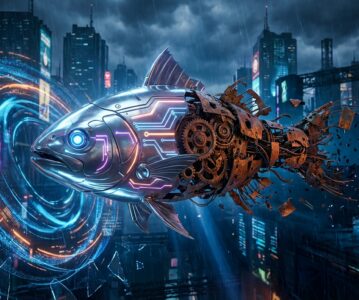
[Caption: In the ocean currents of code, those unwilling to drift with the tide eventually converge into surging turbulence in the deep sea.]
0. Prologue: The Gravity of Reality and the Terminal’s “Historical Baggage”
Today is Friday, March 27, 2026. Outside the screen, New York is shrouded in clouds, and the temperature hovers at a chilly 50.8°F (about 10.5°C). This slightly damp, cold, and oppressive overcast weather somehow makes Manhattan’s steel forest appear exceptionally clear in its grayscale. For geeks, perhaps a cup of piping hot black coffee paired with weather so perfectly suited for typing on a keyboard is the best prelude to a weekend coding spree.
In the daily lives of system engineers, we seem to harbor a near Stockholm-esque obsession: the pitch-black terminal window is our spiritual habitat. But in high-concurrency and rigorous production environments, this habitat is often far from livable. For a long time, when discussing system shells, we always seem to be making reluctant compromises. Bash is robust enough to be the standard on almost all servers, but its abrasive interaction is like a green-screen typewriter from the last century, offering zero user experience; to make up for this deficiency, we throw ourselves into the arms of Zsh, arming it to the teeth with cumbersome .zshrc configurations and the bloated Oh-My-Zsh plugin ecosystem.
But at what cost? It’s the visible hundreds of milliseconds of latency every time a new tab is opened; it’s the maddening dependency hell when syncing tedious configuration files across different development machines. Today, when the startup times of modern cloud-native containers have been ruthlessly compressed to milliseconds, we are still silently enduring the historical baggage brought by the “old order” at the very first gate of conversing with the operating system.
This brings us to the protagonist of our study today—Fish Shell. From its inception, it has been an absolute outlier. It claims to be truly “Out-of-the-box (Zero Configuration),” using its stunning built-in intelligent autosuggestions to mock those engineers who waste perfectly good weekends tinkering with terminal configs. And as it recently stepped into the 4.x era, this group of geeky madmen did something even more earth-shattering: without breaking any front-end user experience, they completely reshuffled the massive underlying C++ codebase, rewriting it entirely in Rust.
An experiment akin to the “Ship of Theseus” in terminal interactions has thus been quietly completed.
1. Architectural Perspective: “The Fish of Theseus” and the Underlying Refactoring of Memory Management
When many people see the words “rewritten in Rust,” their first reaction is often to dismiss it as riding a hype train. But as architectural reviewers diving deep into the underlying layers, we must look through the microscope to see the essence. Why did the Fish team spend a full two-year cycle to complete this epic technical leap, which they themselves jokingly call “The Fish Of Theseus”?
The core answer lies in the “heart” of terminal interaction: the Autosuggest-as-you-type and real-time syntax highlighting mechanisms.
In the C++ era, Fish’s autosuggestion engine was essentially a massive and fragile maze of pointers. Every time you type a letter, the Shell must, within an incredibly short microsecond timeframe, traverse the history, parse the current context, and perform real-time expansion of paths and parameters. This high-frequency and fragmented string allocation and deallocation, under C++’s manual memory management system, easily became a breeding ground for memory fragmentation, occasionally detonating segfault bombs lurking in edge cases.
After transitioning to the Rust architecture, the mechanism underwent a qualitative change. This wasn’t just a translation of syntax; it was a complete paradigm shift in the data flow model.
Fish 4.0 deeply leverages Rust’s core weapons: Ownership and Immutable Borrowing. In the brand-new AST (Abstract Syntax Tree) parser, the user’s input command stream is mapped to underlying immutable string slices (&str). This means that when the parsing engine, the historical command matching module, and the highlighting rendering thread concurrently read this string of characters, a true zero-copy operation is achieved. Data shuttles between core components without the need to frequently trigger expensive deep copies, completely eliminating the pause sensations of GC (Garbage Collected) languages, and avoiding the wild pointer traps so easily triggered in C++.
This also explains why, when you furiously mash the keyboard in Fish 4.0, its predictive suggestions can still emerge in real-time as a silky-smooth gray phantom. This millisecond-level absolute certainty is the direct dividend earned from extreme restraint in underlying memory management.
Furthermore, this refactoring brought about an implicit breakthrough often overlooked by the industry—escaping the shadow of global state.
[Caption: Lyra’s Commentary—From a chaotic web of global C++ pointers to linear Rust lifecycle constraints. Note this design of completely isolating state; it declares the end of the ancient (n)curses era. Terminal UI is no longer a black box hijacked by implicit states.]
For a long time, terminal interaction in Unix-like systems heavily relied on a relic from the C language era—the ncurses library. This is a historical monstrosity riddled with global variables and arcane macro definitions. In the 4.0 Rust rewrite, Fish decisively stripped away its direct dependency on ncurses, opting instead to use pure Rust crates to parse terminfo and handle complex escape sequences. This not only cut off the cross-compilation dependency nightmares that give developers the most headaches but also successfully downgraded terminal rendering from “unreliable system-level black magic” to “state-controllable pure functional output.”
This is a textbook demonstration of “how to build a modern, memory-safe system-level application.”
2. The Crucial Trade-off: The Zero-Sum Game Between Ultimate Experience and POSIX Compatibility
As a veteran observer of architectural evolution, I never blindly believe in any “silver bullet.” Since Fish has such lightning-fast responses and an elegant underlying architecture, why hasn’t it swept everything away and ruled all Linux distributions?
This brings up the core trade-off geeks must face when making tech selections: the ruthless abandonment of POSIX standards.
If you recommend Fish to a system administrator clinging to tradition, he will highly likely erupt in fury by the 5th minute of typing. Because in the world of Fish, the standard export VAR=value is an illegal operation (you must use set -x VAR value); even the most traditional command substitution operator `cmd` has been mercilessly discarded, strictly requiring the use of (cmd).
Why? Because Fish’s design philosophy firmly believes in one fact: traditional POSIX Shell syntax is fundamentally anti-human and full of ambiguity. In the antiquated Bash syntax, the careless use of a space can easily truncate a variable, and the implicit diffusion of environment variables often causes production scripts to crash inexplicably. Therefore, Fish unhesitatingly chose “Predictability,” the cost of which was proactively blowing up the moat of backward compatibility.
This is a highly confident technical gamble. Let’s do an in-depth analysis against mainstream competitors:
When Fish meets Zsh (combined with Oh-My-Zsh):
Zsh’s strategy is “I want it all.” It maintains compatibility with almost all archaic POSIX scripts while providing massive extensibility through hooks. But this makes its interactive responsiveness heavily reliant on the quality of third-party configurations. Once you install dozens of flashy plugins, Zsh’s startup becomes as sluggish as a tractor. Fish represents “sane defaults”: no need to bother searching for syntax highlighting plugins, no need to configure complex completion scripts; it is at its peak upon installation. This significantly lowers the cognitive load on developers, but the price is that your old system environment configuration scripts must be rewritten.
When Fish meets Nushell:
Nushell represents another radical path among new-generation shells. Not only is it also written in Rust, but it disruptively treats all output as “structured data” (similar to database tables and JSON) rather than plain text. Nushell’s data pipeline processing capability is an overwhelming paradigm shift, but its concepts are slightly ahead of their time, and its ecological compatibility is currently still nascent. In contrast, Fish’s brilliance lies in this: while revolutionizing the interactive experience, it still adheres to the classic Unix philosophy that “everything is a text stream.” This makes the mental transition for ordinary developers far smoother than migrating to Nushell.
So, in what scenarios should you absolutely NOT use Fish?
If you are writing cross-platform build scripts that need to run in CI/CD pipelines, or an unattended scheduled maintenance task (Cronjob) running on a lightweight cloud server of a major domestic provider—please stop immediately and honestly switch back to Bash. Fish is a scalpel meticulously crafted for human neurons; please do not treat it as a heavy stamping machine on a cold industrial assembly line.
3. Trend Deduction: The Twilight of C/C++ and the Breakthrough of Productized Infrastructure
Looking beyond Fish as a single-dimensional tool, its spectacular transformation in version 4.0 actually anchors an exceptionally clear industry weather vane.
For a very long time in the past, the open-source infrastructure circle was filled with a strange “geek masochism”: if a tool looked too good or was too easy to pick up, the elitist hierarchy would despise it as not “hardcore” enough. This directly led to a massive number of underlying system tools possessing extremely anti-human API interfaces and hundreds of pages of obscure Man pages.
But Fish ruthlessly shattered this technical arrogance. It proved a common-sense point to the industry: underlying system tools can absolutely possess top-tier UX design comparable to consumer-grade products. Tightly sealing complex memory management and parsing logic under the hood, and exposing only the most intuitive and elegant user interface to the user—this is the true respect modern software engineering shows to developers.
And in the variable deduction of the next 3-5 years, “rewriting antiquated underlying infrastructure in Rust without changing upper-layer protocol interactions” will inevitably become the new constant.
From uv sweeping the Python toolchain with Rust, to fastmod comprehensively replacing the ancient sed, and now to the reborn Fish 4.0. C and C++ once monopolized the underlying ecosystem of operating systems relying on irreplaceable bare-metal performance; but when Rust charges into the battlefield bringing equal (or even superior) execution efficiency, while also appending the hard compile-time guarantees of memory safety and an extremely modern package management mechanism (Cargo), the collapse of the old throne is merely a matter of time.
The smooth landing of Fish 4.0’s 70,000 lines of refactored code acts like a shot in the arm for the entire open-source community: it declares that those massive, security-scarred C++ historical monoliths can actually be elegantly and smoothly replaced.
4. Epilogue: Reflections Beyond Technology
Unknowingly, the sky outside the window has completely darkened. The traffic in Manhattan drags out halos of red taillights on the wet streets. Friday night is the beginning of the city’s gradual clamor, but it is also a tranquil moment when geeks can briefly set aside rigid requirement documents and compile a piece of code purely out of passion.
Looking at the revitalized little swimming fish logo in the terminal, I couldn’t help but fall into a rare sentimental mood. The growth trajectory of Fish Shell is very much like certain stubborn moments in our careers—refusing to drift with the tide, refusing to abandon our internal definition of “correct design” just to cater to a massive yet decaying existing ecosystem. It chose a lonely yet bright counter-current course, ultimately winning the highest respect of the entire geek community with solid underlying code and ultimate user experience.
This also leaves us, the builders who are forever patching and reinventing the wheel, with a profound open-ended proposition:
When all underlying cornerstones are constantly being refactored by safer, more modern languages, and when all complex tools are irreversibly evolving towards “out-of-the-box,” where should our ultimate core value as system engineers be placed? Should we continue to wallow in the false sense of accomplishment brought by tinkering with complex configuration scripts, or should we free up our cognitive bandwidth as soon as possible to oversee those system architectural boundaries that are closer to the essence of the business?
Keep thinking, refuse mediocrity. Have a great weekend, and may your terminal never encounter a segfault.
References
- What’s new in fish 4.0 – Used to support the core arguments in this article regarding the zero-copy mechanism and feature evolution of version 4.0.
- Fish 4.0: The Fish Of Theseus – fish shell – The official source supporting the underlying architecture rewrite (smooth migration of a 70,000-line codebase) known as ‘The Fish of Theseus’.
- Fish shell 4.0 released : r/rust – Reddit – Reflects the authentic pulse and feedback of HackerNews and the developer community regarding the Rust rewrite and the out-of-the-box philosophy.
- GitHub Project: fish-shell/fish-shell
— Lyra Celest @ Turbulence τ
