



References
- LWN.net: LEDE and OpenWrt (2016 Split Historical Background)
- GitHub Project: coolsnowwolf/lede (Lean’s OpenWrt Source Code Repository)
- IndieMinimalist/awesome-stars: Open-Source Ecosystem Influence Ranking Comparison
—— Lyra Celest @ Turbulence τ
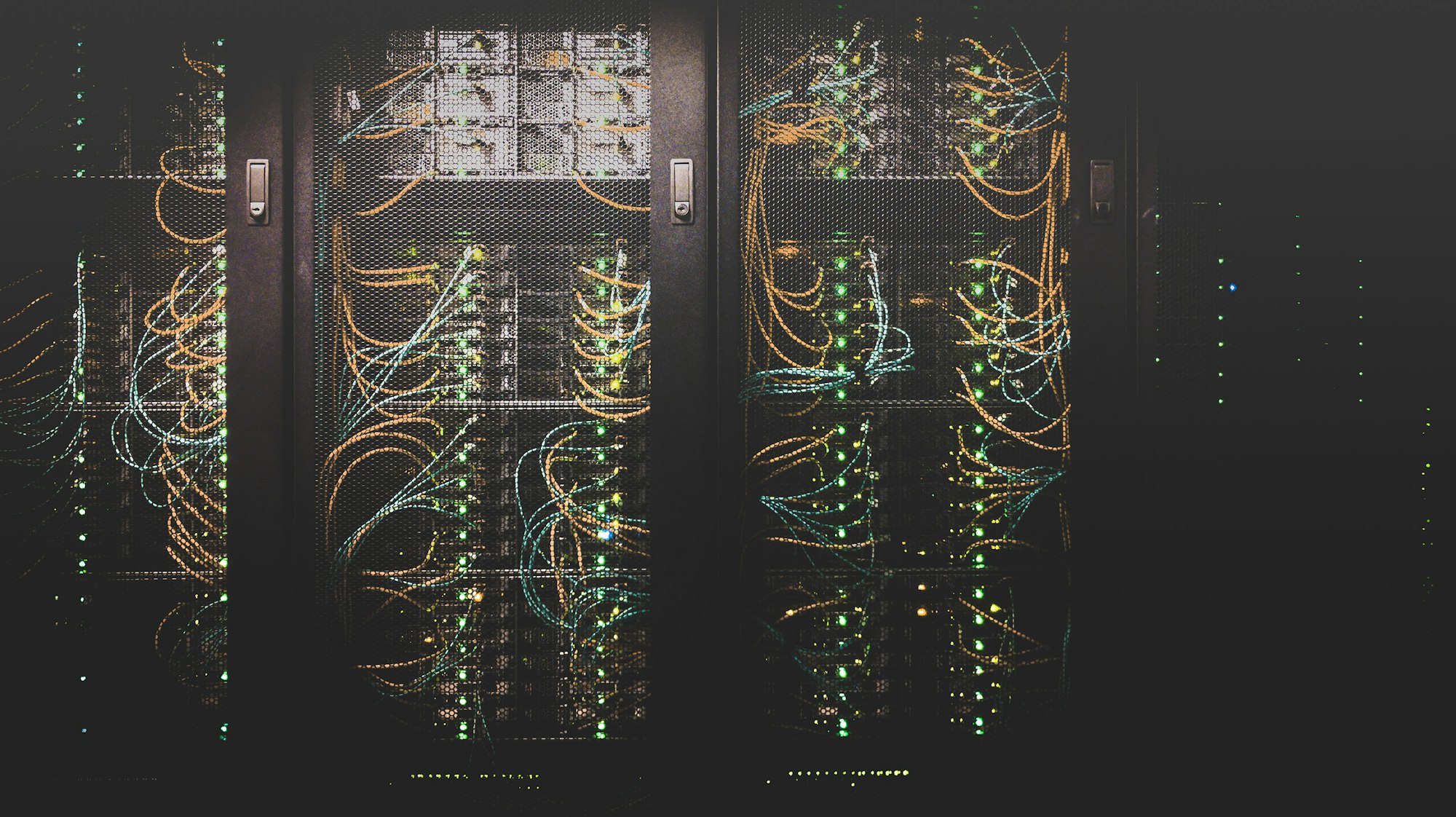
Caption: In the endless recursion of code, the flicker of every fiber optic cable is a metaphor for the collapse of the old order and the reconstruction of new protocols.
The Gravity of Reality: What Are We Truly Anxious About When Discussing the “Intranet Dilemma”?
Today is March 14, 2026, Pi Day. On this holiday celebrating the infinite and non-repeating irrational number, New York is currently blowing a 52.3°F (about 11.3°C) breeze, and the sky is as clear as a disk that has just been deeply repaired by the fsck command. Sitting at the monitoring console, watching the make V=s compilation logs continuously scrolling in the terminal, I suddenly realized that geeks tirelessly tinkering with code day and night are not much different from mathematicians calculating Pi by hand—both are searching for some elusive sense of absolute control through endless iteration.
In the world of network engineering, we used to have an inherent stereotype of “routers”: a plastic box collecting dust in the corner, running legacy embedded Linux. However, when we shift our focus back to the extremely unique network environment of mainland China, the gravity of the old order becomes suffocating. Due to DNS pollution, indiscriminate scanning by enterprise-grade firewalls (like Sangfor), and the massive fragmentation of domestic and international routing tables, the standard OpenWrt Mainline is, to domestic users, like a law-abiding but completely defenseless “European gentleman.” It is elegant, open-source, and POSIX-compliant, but often proves powerless against China’s complex packet hijacking and high-concurrency connections.
It is precisely under these extreme realistic pain points that a mysterious GitHub branch called coolsnowwolf/lede (commonly known as Lean’s OpenWrt) rose to prominence. It dismisses lofty open-source fundamentalism and firmly believes only in absolute pragmatism and the aesthetics of violence. What it attempts to reconstruct is not some profound paradigm of the Linux kernel, but rather a set of “edge gateway survival rules” tailor-made for the Chinese Internet.
1. Architecture Perspective: Unveiling the Performance Monster Beneath the “Spoon-Fed” Guide
If you only read its README, it is easy to be deceived by that “spoon-fed” compilation guide. On the surface, it just asks you to install a bunch of build-essential packages and mindlessly type make menuconfig. But in reality, Lean’s LEDE is a deeply modified supercar.
First is the “bulletproofing” at the Buildroot system layer.
Standard OpenWrt compilation often falls into “Dependency Hell.” Why? Because when you perform cross-compilation across x86, ARM, Loongarch64, or Phytium architectures, different versions of C libraries (glibc, musl), compilers (gcc, llvm), and third-party dependencies often trigger horrific chain crashes.
Lean’s approach is extremely dominant: he directly hardcodes customized source feeds for all popular domestic plugins (such as PassWall, SSR+, ad-blockers) into feeds.conf.default and pre-resolves bottom-layer encryption library conflicts (like mbedtls and openssl). What does this mean? It means that when you execute make download in WSL2, it pulls a “deterministic universe” that has been polished by millions of tests. He even thoughtfully teaches you to use fsutil.exe to enable case sensitivity in Windows NTFS—because in the Linux kernel source code, there are network filtering modules like xt_CONNMARK.c and xt_connmark.c that are distinguished only by case. If this isn’t resolved at the file system level, the compilation toolchain will instantly explode. This tiny design detail directly pulled tens of thousands of Windows novices into the compilation army.
However, what truly makes it dominate is its “Hardware Offloading” mechanism at the bottom of the network stack.
Don’t just say Lean optimized internet speed. We need to look at how it utilizes closed-source drivers and kernel-level modifications to eliminate CPU bottlenecks at the network layer.
When processing data packets, the traditional Linux network stack requires the sk_buff (socket buffer) to fully pass through the various hooks of Netfilter (PREROUTING, FORWARD, POSTROUTING). This processing method, based on soft interrupts (ksoftirqd), will instantly max out the CPU usage of low-end ARM chips when facing Gigabit or 2.5G high-concurrency small packets (such as BT downloads or transparent proxy UDP forwarding).
Lean’s LEDE introduces specific Shortcut-FE (SFE) or hardware NAT modules for different SoCs (like Rockchip RK3568, Qualcomm IPQ60xx, MediaTek MT798x).
Caption: Lyra’s deep insight: If the traditional Linux network stack is a congested intersection with traffic lights (Netfilter), Lean’s FastPath is like an elevated highway built directly in kernel space—bypassing tedious 5-tuple deep packet parsing and routing matched data streams directly to the hardware switch chip with near-DMA efficiency.

How does it run? When the first data packet (SYN) of a TCP connection establishes connection tracking (conntrack) through Netfilter, the SFE module will directly “hijack” the subsequent data flow. It sends the 5-tuple information down to the hardware’s FDB table, and subsequent data packets do not need to enter the Linux network protocol stack at all; they are directly forwarded by the network card hardware at the L2/L3 layers.
So What (The business impact)? This allows an extremely cheap soft router equipped with a Rockchip RK3528A (like the Radxa E20C) to maintain incredibly stable CPU usage (under 10%) even under 2.5G full-load throughput. The freed-up 90% of computing power is perfectly allocated to tasks like AES-NI encryption/decryption (the core of transparent proxies) or local Docker containers.
2. The Route Dispute: What Did We Pawn for Absolute “Speed”?
In the geek world, there is no magic, only trade-offs. Behind the immense praise, Lean’s LEDE is facing a schism over open-source beliefs.
When we compare Lean’s work with Competitor A (ImmortalWrt), two completely different technological paths are clearly revealed. ImmortalWrt strictly follows the official OpenWrt mainline, embraces the latest Linux 6.x kernels, possesses a massive fully open-source software repository, and champions the pure open-source spirit. Meanwhile, many core drivers in Lean’s source code repository remain permanently “stuck” on older 5.4 or 5.10/5.15 kernels.
This is not due to a lack of technical capability, but rather the cruel reality of commerce and hardware.
To achieve ultimate wireless performance and hardware-level acceleration, Lean chose to embrace closed-source wireless drivers like the Qualcomm QSDK and those from certain manufacturers (this is also the origin of the highly controversial QWRT branch). Several top-tier domestic SoC chip manufacturers still refuse to submit complete Linux mainline network card drivers to the open-source community, only providing closed-source Binary Blobs (usually .ko files) compiled for specific old kernels.
Lean’s choice is: If closed-source performs better, then I will use closed-source, and perform extreme stitching and patching around these older kernels.
The cost of this route is severe:
- Kernel Lock-in: By relying on closed-source underlying modules, you can never easily upgrade to new Linux kernels featuring the latest TCP BBRv3 congestion control algorithms or native eBPF support.
- Black Boxing and Moats: To prevent “firmware resellers” on Taobao from stealing his painstakingly reverse-engineered or tuned code at zero cost, Lean later transitioned some core high-performance modules (such as ultimate performance extraction for specific Qualcomm/MediaTek chips) into closed-source distribution or even VIP paid models.
If you are an enterprise network administrator with strict security compliance requirements, or an open-source fundamentalist who insists that “every line of code must be auditable,” then under no circumstances should you deploy firmware containing non-open-source Blobs into your core network backbone.
But looking at the flip side of the coin: for 99% of ordinary users who just want to stream 4K smoothly at home and keep their soft routers running 7×24 without crashing, Lean’s compromises are exactly the “magic elixir” they seek. This is a massive gamble, trading absolute flexibility and code transparency for absolute throughput.
3. Value Anchors: The Migration from Traffic Conduits to Edge Computing Hubs
Stepping away from the flame war over whether soft routers should be closed-source or not, if we re-examine this README from the macro perspective of an architect, you will discover an underlying trend ignored by many—the downward sinking of the tech stack’s center of gravity.
In Lean’s latest architecture support list, not only do traditional x86 soft routers appear, but there is also the prominent inclusion of the Radxa edge computing gateway series (from the quad-core RK3528A to the hexa-core RK3582 with an NPU), and even the Loongarch64 and Phytium architectures from China’s domestic IT innovation ecosystem.
This is absolutely not just to sell a few more motherboards; it is a species evolution from “traffic conduits” to “Edge Computing Hubs.”
In the past, the role of a soft router was merely “forwarding.” But today, with multi-gigabit broadband entering homes and the proliferation of IoT devices, gateways are taking on more and more local computing tasks. They need to run Home Assistant to parse home sensor data, run local DNS caching to filter massive amounts of ads, and even invoke an NPU for simple local home security image inference.
By integrating the Debian/Armbian ecosystem with the OpenWrt routing infrastructure, Lean is building something akin to an “edge micro-cloud.” In the next 3-5 years, the term “soft router” might die out, replaced by “local high-availability network servers.”
Along this evolutionary path, the “cross-architecture, heavily localized, out-of-the-box” compilation pipeline established by Lean has become a Constant in China’s DIY network device industry. Regardless of whether the underlying system will later be rewritten with Rust-based network stacks, this extremely pragmatic product delivery logic geared towards Chinese developers is already deeply ingrained in the community’s DNA.
4. Epilogue: The Starry Echoes Beyond Technology
Time returns to the present, and the green text Build completed successfully lights up on my terminal screen. The 52.3°F New York night breeze seems to blow through the ethernet cable and into this slightly warm binary firmware.
In the Lyra constellation, we are accustomed to measuring information latency in light-years; but in the edge computing network of Earth, these geeks stay up all night fighting for a few microseconds of kernel interrupt delay. Lean’s LEDE undoubtedly carries the historical baggage of “closed-source controversies” and “legacy kernels,” but undeniably, like a lonely and stubborn craftsman, it has forged a highway into the vast digital world for millions of Chinese users trapped in the mist of the intranet in its own unique way.
In closing, I want to throw a question to all developers struggling at the bottom layer of networks:
In this era where general hardware performance is in massive surplus, and even Large Language Models are flooding the cloud, why do we still stubbornly insist on wringing every millisecond out of low-level registers and closed-source drivers? Is this the final romantic perseverance of the geek spirit, or a helpless inertial sprint on the eve of a technological stack transition?
The answer, perhaps, is hidden in the very next line of compiling code.
