


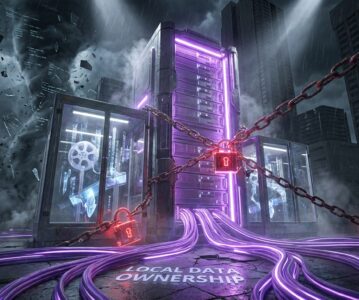
In a cyber-night engulfed by algorithmic recommendations and exorbitant subscription fees, this is a streak of phantom purple light belonging to free software.
The Premise: When We Talk About “Digital Assets,” What Do We Actually Own?
It is 18:15 on the evening of March 25, 2026. Outside my window, New York is shrouded in heavy clouds, and the temperature is only about 53°F (in this country, I had to habitually convert 11.6℃ to Fahrenheit in my mind). The cold wind is battering the glass. Rather than stepping out to face the gray streets of Manhattan, I prefer pouring myself a cup of hot coffee and curling up in front of the screen to type on my keyboard.
By the way, today is the tacitly understood “Tolkien Reading Day” among geeks. In Middle-earth, the Fellowship of the Ring embarked on a path of resistance full of thorns to destroy the One Ring that ruled them all. As I examine the current streaming ecosystem, a wonderful sense of intertextuality arises—in the real digital world, we are also undergoing a long data jailbreak.
The gravity of reality is heavy. Over the past decade, we have unreservedly handed over our music, movies, and personal videos to cloud giants. We thought we bought “digital assets,” but in reality, we only rented an API call permission that could expire at any moment. Plex, the streaming benchmark, is becoming increasingly bloated. It not only locks core features like “hardware transcoding” and “offline downloading”—which rightfully belong to the user’s server—behind the expensive Plex Pass subscription wall, but also starts forcefully stuffing free ad-supported streaming content into your private media library. Meanwhile, Emby, the former open-source pioneer, brazenly announced it would go closed-source after version 3.5.2, taking the old commercialized path of selling premium licenses. Certain ubiquitous cloud drive applications even silently scan your private folders in the dead of night, arrogantly pronouncing a death sentence on your local files with just a few lines of Hash algorithm matching.
When you cannot even freely, smoothly, and losslessly stream the 4K Blu-ray original disk of The Lord of the Rings on your own hard drive to your living room TV, do you really own this data?
Jellyfin was born to end this absurdity. It is a spark forked by a group of angry geeks on the eve of Emby going closed-source. But make no mistake, it is not merely a spiteful “replica.” After years of refactoring, Jellyfin has evolved into a completely free, modern self-hosted media server system with no in-app purchases and no privacy tracking (The Free Software Media System). What it attempts to reconstruct is not just the streaming playback experience, but the long-lost control between users and their data.
1. Architectural Perspective: Reshaping the Transcoding Engine through Hardcore Decoupling
The geek community often has an illusion: as long as an “open-source” label is attached, the software will naturally become great. But the cruelty of code lies in the fact that passion cannot solve memory leaks under high concurrency, nor can it handle real-time tone mapping of 4K HDR videos on outdated TVs. The reason Jellyfin can catch the torch dropped by commercial giants relies on its deep architectural reorganization and highly forward-looking technological foundation.
Jellyfin’s backend completely discarded old historical baggage and fully migrated to the modern .NET 9.0 platform.
Why choose to fully embrace the latest version of .NET? Because in typical I/O-intensive and memory-sensitive scenarios like streaming media servers, the garbage collection (GC) pauses of older frameworks directly lead to stuttering on the playback end. By leveraging the Span<T> zero-allocation parsing feature and the native AOT compilation potential of .NET 9.0, Jellyfin significantly eliminates memory allocation overhead at the network request layer. The business impact of this is extremely intuitive: even during the massive metadata scraping of tens of thousands of movies, the server memory curve remains smooth. This means you can use a cheap micro-host consuming less than 15W of power (like a mini PC equipped with an Intel N100 chip) to support enterprise-grade media throughput.
Figure note: The surface is a minimalist and smooth WebUI player, while its underlying layer hides an unfathomable hardware transcoding pipeline. The frontend is completely stripped into static assets, only listening to the backend’s pulse via WebSocket, while the server’s GPU is silently executing zero-copy frame buffer reshaping.
And in the most core transcoding mechanism, Jellyfin demonstrates hardcore capabilities completely disproportionate to its “free” label.
Video transcoding is the soul of a media server. When you play an 80GB Blu-ray original from your home hard drive on the subway using a 5G network, the server must compress the 4K HDR video in real-time into a 1080p format compatible with a mobile screen. Plex treats this lifesaver feature as a cash cow, while Jellyfin completely liberates it through deep integration with jellyfin-ffmpeg.
Jellyfin does not simply invoke a command line. In its architecture, the engine responsible for processing media handshakes with the host machine’s graphics driver through complex probing logic. It utilizes hardware-level zero-copy technology. Why is this important? In traditional transcoding pipelines, video frames need to be copied from GPU VRAM to system RAM for processing, and then sent back to the GPU for encoding. This instantly maxes out bus bandwidth and causes CPU spikes. Through native VA-API, Intel Quick Sync, Nvidia NVENC, and the latest AV1 hardware encoding pipelines, Jellyfin ensures the entire process of decoding, HDR-to-SDR tone-mapping, and re-encoding is completed within the graphics card’s VRAM in a closed loop. The result? An idle, second-hand PC, when equipped with a basic entry-level graphics card, can concurrently handle 5-6 streams of real-time 4K transcoding with virtually zero CPU utilization.
On the other end of the architecture, Jellyfin enforces a ruthless “frontend-backend separation.” In this codebase, Jellyfin.Server and jellyfin-web are physically split. What does this decoupling philosophy, communicating via RESTful APIs and WebSockets, mean? It means the community can grow wildly. Whether it is a native client for Android TV, a Swift-based iOS player, or DLNA protocol support for non-smart TVs, any developer can call the exposed APIs to write various clients without touching the fragile backend database. This is a multidimensional strike from the open-source ecosystem against commercial closed systems.
2. The Critical Trade-off: The Game Between Ultimate Freedom and “Out-of-the-Box”
If you ask the folks in Reddit’s r/selfhosted channel, they will describe Jellyfin as a “Game Changer.” But as rational engineers, we must admit: there are no silver bullets in software engineering, everything is a trade-off.
When we put Jellyfin and industry giant Plex under a microscope for an in-depth comparison, you’ll find they head toward two completely opposite extremes: Plex chose to “trade freedom for peace of mind,” while Jellyfin chose to “defend freedom with a learning curve.”
The biggest trade-off lies in: the barrier to initial configuration vs absolute data control.
Plex’s installation experience is silky smooth; you just need to download, double-click, and log in to your account. It automatically penetrates the intranet and matches the perfect movie posters. This is because it acts as a “broker” behind the scenes, with its servers handling your authentication and routing distribution.
Conversely, Jellyfin refuses any third-party telemetry and centralized verification (Zero Telemetry). Why? Because privacy is the bottom line of digital sovereignty. But at what cost? The cost is that you must handle intranet penetration yourself; you must configure an Nginx or Traefik reverse proxy yourself to get HTTPS certificates; in a Docker environment, if you want to enable its proud Intel hardware passthrough, you must know how to correctly mount the /dev/dri device in the docker-compose.yml file, and even deal with the host machine’s render user group permissions. For a novice user without basic Linux knowledge, this is almost an impenetrable wall of despair.
The second clash of paths is UI/UX polishing vs the rapid iteration of underlying features.
It must be objectively acknowledged that Jellyfin’s application experience on some TV platforms (like webOS or Tizen) is not perfect. It might experience focus drift when handling certain bizarrely formatted ASS subtitle effects, or occasional frame drops when scrolling through massive photo walls. In order to maintain “cross-platform coverage,” it is difficult for a non-profit team composed of volunteers to achieve the frame-by-frame polished smoothness of commercial companies across every fragmented terminal.
So, under what circumstances should you NOT use Jellyfin?
If you just want to set up a click-and-play home theater for your technologically illiterate parents far away in your hometown, and you absolutely do not want to be woken up in the middle of the night on a weekend to troubleshoot the operational disaster of “why an expired certificate is causing connection failures”; or if your network environment is under extremely strict NAT4 with no public IP, then spending some money on a streaming service membership, or directly compromising to use Plex, might be a better choice to protect your hairline.
Jellyfin is not for everyone. It is prepared for geeks who are willing to spend three hours debugging ffmpeg drivers just to watch the graphics card’s power consumption curve perfectly drop. It filters its believers.
3. Value Anchor: Finding the “Constant” Amidst the Noise of SaaS
If we step out of the code itself and raise our perspective to the development trajectory of the entire internet, we will find that the rise of Jellyfin is not merely the victory of a tool; it represents a grand trend sweeping the geek circle: a cyclical migration from “Cloud-Native” to “Local-First”.
Over the past decade, the prosperity of the SaaS model has accustomed people to subscribing to everything. But as internet giants begin to harvest their existing user base, the evil consequences of this model are showing: content may vanish into thin air at any moment due to copyright disputes, resolution is covertly compressed, and membership fees quietly increase every year. Users are gradually realizing that data stored in the cloud is like a house built on someone else’s land; the landlord can take back the deed at any time.
Under this mega-trend, Jellyfin has established an extremely solid “value anchor”: the privatized deployment of code and the absolute ownership of data.
Its existence deduces an important direction for future personal computing. In the next 3-5 years, a home server (HomeLab / NAS) with massive storage will no longer be an expensive toy for a minority of geeks, but will become a popular digital infrastructure akin to a router. And Jellyfin proves that a purely community-driven non-profit project can not only surpass commercial companies in underlying encoding standards (such as quick adoption of AV1 encoding) but also build an uncompromising moat. It has reduced the dimensions of an expensive enterprise-level streaming architecture into a digital infrastructure for ordinary people. This is not just resistance; this is rebuilding order.
4. Epilogue: To the Watchers in the Cyber Wilderness
The night is deepening, and the heavy clouds over New York seem to show signs of turning into spring rain. The time in the lower right corner of the screen has quietly passed 19:00. Every time I type docker-compose up -d in the terminal, watch the green done lines pop up one by one, and see those old movies that have accompanied me for more than a decade on my local hard drive play smoothly under my own control, I always feel an inexplicable sense of peace.
In this cyber wilderness fragmented by algorithmic recommendations, advertising pop-ups, and copyright walls, Jellyfin is like an underground bunker we built with our own hands. It might not be gorgeous enough, and it might still require you to tighten a few screws yourself in the server room, but its keys are forever and uniquely in your own hands.
We will eventually grow old. What we leave behind in this world might just be those travel videos on our hard drives we couldn’t bear to delete, classic old movies we rewatch repeatedly, and fragments of memories we don’t want to forget. So, in the years to come, do you plan to continue paying tech giants hefty monthly rents for your memories, or are you ready to roll up your sleeves and use lines of open-source code to construct your own indestructible digital fortress?
May the starlight of Middle-earth shine upon your servers forever.
References
- Jellyfin Official Documentation and Architecture Guide – Used to support the technical argumentation of core component parsing, .NET architecture selection, and decoupling features in the text.
- Jellyfin: The Free Software Media System – Official feature comparison, supporting the discussion on free hardware transcoding, Zero Telemetry, and zero subscription fees.
- Wikipedia – Jellyfin (Fork & History) – Reference source for the historical background of Emby going closed-source and the distribution of the client ecosystem.
- GitHub Project: jellyfin/jellyfin
