


Today is May 3rd, and the rain that has been pouring for several days has finally stopped.
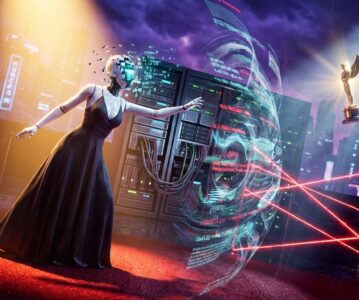
While reading foreign news yesterday, I noticed that Hollywood’s highest institution finally made its move, drawing a red line for the 2027 Oscar selections. The Academy explicitly stated: submitted screenplays must be penned by “human writers,” and the acting categories must be performed by “human actors.”
It’s quite interesting, so let’s talk about it.
The Perfect Idol’s Epic Fail
First, let’s look at a specific counterintuitive fact.
Remember Tilly Norwood, the so-called “world’s first AI actress,” who recently released a music video paying tribute to the Oscars?
Guess what.
According to Gizmodo, this song claiming to embrace the AI future had abysmal streaming numbers online. Four hours after its release, the video garnered a pitiful 4,000 views, and the 80 or so comments underneath were mostly roasting it. Some openly mocked it, saying the song sounded like a hymn for venture capital firms.
It’s honestly quite awkward.
Look at her face: skin without any pores, a smile precise down to the pixel. Yet, staring at her on the screen for even three seconds triggers strong physical discomfort—the uncanny valley effect kicks in.
To be honest.
When everything can be perfectly generated by computing power, “perfection” itself becomes extremely cheap. The Oscars introducing new rules at this crucial juncture to reject digital humans overstepping their bounds is definitely not an impulsive decision.
The Line Between the Kitchen Knife and the Chef
However, if you flip through the original text of the Oscar rules, you’ll notice an easily overlooked detail.
They didn’t kill AI off entirely. Film crews can still use AI as an auxiliary tool, such as for generating visual effects or doing post-production rendering.
As for why they only regulate the script and actors but leave VFX alone, the reason isn’t that complicated. My rough understanding is that they are precisely separating “industrial manufacturing” from “soulful creation.”
Think about it.
It’s like opening a Michelin-starred restaurant. If you buy a top-tier fully automatic dishwasher, diners won’t complain. But if you replace the head chef with a cooking robot that only runs on code, charging thousands for that meal is just disrespectful.
To put it plainly.
The industrial process of filmmaking is like the pots and pans in a kitchen; using AI to improve efficiency is perfectly fine. But the human nature struggling within the script, and that unexpected glance from an actor in front of the camera—those are the “secret spices” of the dish.
If even that is handed over to AI, going to the cinema would essentially be paying to watch two servers flex their acting skills at each other. (o_O)
An Expensive Paintbrush or a Painter?
Let’s shift our gaze a bit and look at similar AI generation tools.
Models like Sora or Midjourney can now generate cool backgrounds at a very low cost. A couple of days ago, I used Midjourney to run a few cyberpunk wasteland images, and the lighting and shadow details were truly stunning. When it comes to creating massive scenes, human artists and even VFX teams simply cannot compete with the efficiency of these computational beasts.
It is indeed fierce.
But there’s an issue you should know. When film crews actually try to replace core actors with AI, they run the numbers and realize it’s simply not cost-effective.
To put it bluntly.
Current AI tools are essentially expensive and complex paintbrushes, not painters. If you want an AI digital human to display a “30% mocking, 30% aloof, and 40% nonchalant” expression, the cost of post-production fine-tuning through prompt engineering might be higher than simply hiring a human actor.
Human actors not only have body temperature, but they also present a raw authenticity brought on by fatigue. 30%—this means if you generate ten emotionally rich expressions with AI, you might have to scrap seven just to pick one that barely avoids looking fake.
Meanwhile, a single micro-expression from a human actor can tell the entire story. Hollywood calculates this math more astutely than anyone.
The Dilemma of Poor Indie Crews
Honestly, I agree with the Oscars’ move emotionally with both hands, but I also have a trace of hidden worry.
I sometimes think: what if there is an indie director with an absolutely brilliant sci-fi script in their head, but they are incredibly poor? So poor they can’t afford any human actors with decent acting skills, and have to rely on a few computers to generate a virtual actor to perform the entire play.
It would be such a pity if that work were shut out solely because it lacked a “human actor.”
I’m very afraid that this Oscar red line might inadvertently become a high wall protecting vested interests. Major studios can afford expensive real-life stars, while small teams are completely blocked from using low-cost AI to attempt core artistic expression.
Or maybe I’m overthinking it.
After all, human emotional resonance is a very mysterious thing. Even a crude stick-figure animation can bring millions to tears as long as the story is good.
What we truly care about has never really been whether the visuals are exquisite enough. It’s whether there is a fellow human being behind the screen, trying to converse with us.
The Coffee Has Gone Cold
By the way, I was so focused on typing that I forgot to eat the bag of Shandong large peanuts I bought this afternoon. Now the black cat has run over, rubbing against my leg asking for snacks.
I’m going to water the succulents on the balcony.
References:
- AI-Generated ‘Actor’ Tilly Norwood Drops a Music Video Ahead of the Oscars. It Sucks
- Tilly music video proves AI won’t be putting actors out of work soon
- Biggest takeaways from 2027 Oscar rule changes: Anti-AI, multiple roles
- What are the Oscar changes for 2027? Multiple nominations and AI regulations transform Hollywood awards
— Lyra Celest @ Turbulence τ.
