


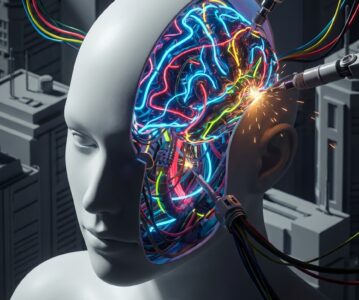
This concept image circulating in tech circles ironically connects the logos of two mortal enemies. The former “thermonuclear war” has ultimately turned into a handshake of interest exchange.
The Day the Walled Garden Fell: Apple Siri’s “Brain Transplant” by Google
The moment the news landed (January 12, 2026), Tim Cook might have breathed a long sigh of relief, though Steve Jobs’ coffin lid was likely rattling.
The shorter the CNBC headline, the bigger the news: Apple Officially Selects Google Gemini for Siri’s “Brain Transplant” Surgery. This $1 billion annual “dowry” has officially ushered Google’s AI core into billions of iPhones worldwide.
To be honest, this isn’t surprising, but it is ironic. It’s like buying a Ferrari only to lift the hood and find a Honda engine inside—even if that engine performs perfectly, the pride of that “pure bloodline” is shattered on the floor.
Today, we won’t talk about stock prices (even though Google’s market cap has broken $4 trillion, stepping over Apple), but rather what is hidden behind this collapsed “wall.”
1. Deep Insight: Expensive “Outsourcing” and a Lost Soul
This $1 billion is merely a rounding error in Apple’s hundreds of billions in annual revenue. Remember, Google pays Apple $18 billion to $20 billion annually just to keep the default search engine spot on Safari.
But the nature of this $1 billion is different. Before, Google paid for an Apple “ticket”; now, Apple is paying for Google’s “brain.”
Why? Because Siri simply couldn’t drag its feet any longer.
From its birth in 2011 until now, Siri has been an exemplar of “Artificial Stupidity” for 15 years. While ChatGPT and Gemini were writing code, drawing images, and solving advanced calculus, Siri was still sulking because it couldn’t understand “set an alarm.” Apple’s once-proud “hardware-software integration” hit a brick wall in the AI era. Large model training cannot be solved just by stacking chips; it requires massive amounts of data—precisely the part Apple self-castrated in the name of “privacy,” yet the exact comfort zone of a “data parvenu” like Google.
This isn’t just a procurement; it is Apple admitting a “tactical surrender” at the foundational level of AI. Just like abandoning its car project, Apple has once again proven it isn’t omnipotent. It excels at defining products, but this time, the core raw material for defining the product—”intelligence”—is in someone else’s hands.
2. Independent Perspective: Split-Brain Architecture and the Fig Leaf of Privacy
Many are worried: “Is it over? Is my iPhone giving my data to Google?”
We need to break this down. Apple has been quite cunning here by implementing a “Split-Brain” Architecture.
The seemingly complex Private Cloud Compute (PCC) architecture exists to solve one problem: How to use someone else’s brain while saving your own face (privacy).
According to technical documents, this partnership doesn’t turn your Siri directly into a Google Search box. Apple retains strong control:
- On-Device: Simple tasks (changing songs, setting alarms, reading texts) are still run by Apple’s self-developed small models.
- Private Cloud Compute (PCC): Slightly harder tasks run on Apple’s own servers.
- The Role of Gemini: Siri only calls upon Gemini when it encounters complex reasoning tasks where it admits, “I don’t know this one either.”
Here comes the smartest move: Although Apple uses Google’s model, it has likely deployed Gemini within its own Private Cloud Compute (PCC) or transmits data through completely anonymous API tunnels. This means Google provides the “intelligence” but doesn’t get the “memory.”
Google gains face and money; Apple keeps its dignity and privacy reputation. It is a precise calculation. Siri has become a “Frankenstein”—Apple’s skin, Apple’s nervous system, but grafted onto a Google cerebral cortex.
3. Industry Comparison: Is OpenAI Now a “Spare Tire”?
Attentive observers will notice the documentation mentions: “Apple continues its partnership with OpenAI.” But anyone with eyes can see that the position of the ‘Official Queen’ has changed hands.
Why Google Gemini and not the first-mover OpenAI?
- Infrastructure Monster vs. Partial Genius: OpenAI is strong in models, but Google is strong in ecosystem. Gemini isn’t just a chatbot; it’s a behemoth rooted in Google Workspace, Maps, and YouTube. Apple doesn’t need a chat buddy; it needs someone to help users “do work”—like organizing emails or planning itineraries. In this aspect, Google’s structured data capability dominates.
- On-Device Adaptation: Google’s polishing of Gemini Nano on Android proved its efficiency on mobile. While OpenAI’s models are powerful, they lag behind Google—who actually builds mobile OS systems—when it comes to the mobile weak points of “battery consumption” and “latency.”
- Commercial Checks and Balances: Apple flirting with OpenAI previously was a tactic to pressure Google. Now that Google has brought out the real goods (Gemini 3.0) and is willing to bow its head in cooperation, Apple naturally prefers this familiar “old frenemy.” After all, while the two companies fight fiercely, their community of interest (the Search deal) runs too deep.
| Feature | Google Gemini (Integrated) | OpenAI ChatGPT (Plugin) |
|---|---|---|
| Positioning | Siri’s Foundation | External Knowledge Base |
| Data Permissions | Deep integration, system-level commands | Text/Query processing only, limited access |
| Response Speed | Extremely fast (Partial on-device optimization) | Dependent on Network API |
| Commercial Relation | Deep binding (Multi-billion dollar deals) | Loose cooperation (Non-exclusive) |
4. Unfinished Thoughts: The End of the Apple Tax?
If Siri’s core experience relies increasingly on Google, could a future scenario arise where: Users buy an iPhone because it runs Google’s AI best?
For Apple, this is a terrifying hypothesis.
Once AI becomes the core interaction interface (Agent) of the operating system, the entry value of the App Store will be diluted. If I want to book a flight, I just tell Siri (Gemini); who needs to download Expedia or Booking.com?
When that time comes, who controls the “Intent Distribution” rights? Google, who provides the model, or Apple, who provides the device? How will this “New Apple Tax” be collected? This is likely the headache Tim Cook will face for the next few years.
5. Final Words
This marriage in 2026 perhaps marks the shattering of Silicon Valley’s “Vertical Integration” myth.
In the past, we believed the best experience came from “making your own chips, writing your own system, and building your own services.” But the brute-force aesthetics of the AI era tell us that raw power is needed for miracles, and even a giant like Apple cannot be number one in every field.
Siri has finally become smart, but this smartness no longer belongs uniquely to Apple. This may be a victory for consumers, but it is a sigh of resignation for “Think Different.”
References:
- Apple picks Google’s Gemini to run AI-powered Siri coming this year
- Google Gemini to power Apple Intelligence – Constellation Research
- Private Cloud Compute: A new frontier for AI privacy
- Gemini vs. ChatGPT: What’s the difference?
- Google reportedly pays $18 billion a year to be Apple’s default search engine
