


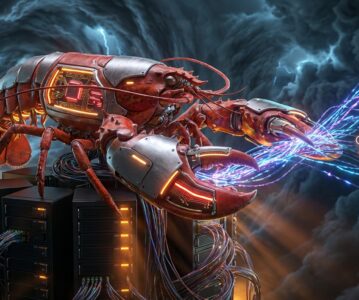

In an AI bubble filled with “Chat with PDF” apps and “One-click PPT” generators, Peter Steinberger (the hardcore developer behind PSPDFKit) has suddenly returned, tossing out a “space lobster” named Clawdbot.
This isn’t just interesting; it has thorns.
The lobster’s slogan is “EXFOLIATE! EXFOLIATE!” (Shedding skin). Sound like a beauty ad? No, it’s mocking us tenants who are still paying the “idiot tax” to cloud giants—it wants us to shed our dependence on SaaS and grow our own “exoskeleton.”
1. The Lobster’s Ambition: Installing a “Nerve Center” for AI
Most people’s imagination regarding AI stops at the “web chat box.” But Clawdbot drills into a blind spot with extreme precision: the Gateway.
What is your current AI experience? You ask for code in ChatGPT, turn around to explain it to a colleague in Slack, then go home and send a shopping list to your wife on WhatsApp. Your data is fragmented; your AI has amnesia.
Clawdbot doesn’t care about being a “better chat box.” If you look at its architecture, you’ll see it’s actually a locally running “Air Traffic Control Tower.”
This seemingly ordinary geek desk is actually the birthplace of Clawdbot. Note the logic behind the multiple screens: all information streams must eventually converge locally.
It connects your WhatsApp, Telegram, Slack, Discord, and even iMessage to a local ws://127.0.0.1:18789 port. This isn’t just aggregation; this is a coup.
What does this mean? It means you don’t need to log into ten apps to find AI. Wherever you issue commands, the brain behind it (an Agent running on your local Mac Studio or Linux server) receives it and shares context.
This “reverse centralization” approach is extremely savvy. It demotes tech giants’ chat apps to mere UIs (User Interfaces), while locking the Brain and Memory firmly on your own hard drive.
2. “Violent Aesthetics” Only Geeks Understand
Clawdbot’s tech stack selection is full of Peter Steinberger’s strong personal aesthetic—both advanced and primitive.
- Docker Sandbox: It doesn’t just run code lightly; it gives every Session an independent Docker container. Want the AI to run an
rm -rftest? No problem—it’s a sandbox; if it blows up, just restart the container. Cloud AI can’t give you this sense of security. - Tailscale Tunneling: This is a stroke of genius. It doesn’t rely on a public IP, but networks directly via Tailscale. You send a WhatsApp message via 4G in a coffee shop, and your Mac Mini at home receives the instruction and gets to work. This is true “Private Cloud.”
- A2UI (Agent-to-UI): It even implements a
Canvas, allowing the AI to render interfaces for you in real-time.
But let me pour some cold water on this. This design ensures that, for now, it remains a geek’s toy.
You want to use it? You need to know Docker, Tailscale, API Key configuration, and even how to read GitHub error logs. For the average user, this lobster’s shell is too hard to crack.
But that’s exactly what makes it sexy. It doesn’t intend to please everyone; it serves only those with a hygiene obsession regarding data control.
3. When Local Routing Meets the Cloud Brain
If it were purely a local LLM (like Ollama), current model capabilities aren’t enough to handle extremely complex logic. Clawdbot is smart because it uses a Hybrid architecture.
Its recommended configuration is Anthropic Pro/Max + Opus 4.5 (a model version that, while seemingly distant in the docs, hints at its hunger for top-tier reasoning capabilities).
Clawdbot’s ambition goes beyond conversation; through the “Execution Layer” in the architecture diagram, it reaches into your local files, camera, and even the terminal command line.
This gets interesting:
- Open WebUI is like building a local ChatGPT web version.
- Ollama hands you the engine to run models locally.
- Clawdbot, however, strings these together and connects them to your life’s pipelines (chat software).
It doesn’t produce models; it is the model’s broker. It solves the “last mile” problem of model deployment: How do I let the strongest model seamlessly intervene in my most trivial daily routines?
4. If the “Gateway” Had a Soul
I found a file named SOUL.md in the documentation.
This isn’t just a prompt; this is the “persona” Peter injected into the lobster. While commercial software desperately tries to trap AI in that cold “assistant” box, Clawdbot allows you to define its soul.
But I have a lingering worry: The fragility of the dependency chain.
Clawdbot relies heavily on third-party APIs (WhatsApp, Discord, Anthropic). What if WhatsApp bans your Bot account? What if Anthropic raises prices? This survival mode of “parasitizing” the cracks of giant ecosystems is destined to be a form of guerrilla warfare.
Furthermore, when Session to Agent (Agents talking to each other) becomes the norm, will you find your CPU busy “holding meetings” while you, the human owner, can’t get a word in?
5. Don’t Look Back, It’s Just You
Clawdbot might not become the next unicorn product (it might even be too hardcore to popularize), but it is a flag.
It reminds us: In the AI era, the price of convenience is usually sovereignty.
When we get used to uploading docs to ChatGPT, pasting code to Cursor, and sending photos to Midjourney, we have effectively outsourced our brains. Peter Steinberger uses this red lobster to tell us: You don’t have to do that. It can be a bit troublesome, a bit of a hassle, but keep your brain at home.
This lobster isn’t tasty; the shell is hard and prickly.
But it tastes like freedom.
References:
