


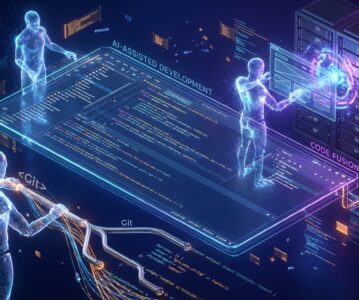
Design is No Longer a Handoff, But a “Concurrency”
The division of labor between design and development is often romanticized as a “relay baton between art and engineering.” Reality is more like bumping shoulders while trying to pass a water cup while running. Pencil spreads an infinite canvas inside the IDE, ensuring design never leaves the coding scene; you lift your hand, and it lands right in the repo. It sounds like a tool upgrade, but it’s actually a rewrite of the collaboration protocol.
It turns “design files” into readable and writable open formats, placing them in the code repository to be branched, merged, and rolled back via Git—manipulating the interface just like source code (Source: pencil.dev, EveryDev.ai). Simply put, it pulls design from being an “artwork” back to being an “asset,” and from an “outsourcing context” back to an “engineering context.”
This matters right now because we are at the intersection of AI agents and the instrumentalization of IDEs. Pencil isn’t just for drawing UIs; it is an MCP-driven canvas that turns AI agents into “parallel teammates” capable of generating screens, refining flows, and synchronizing code within the same context (Source: pencil.dev).
In short: Design is no longer a translation problem from screen to code; it is becoming “multiple expressions of the same language.”
Quote 1: When design is put into the code repository, creativity gains a version number.
You Think It’s a “Design Pattern,” But It’s a “Power Shift”
Pencil emphasizes “AI multiplayer,” encouraging multiple agents to generate interfaces and flows in parallel (Source: pencil.dev). This sounds like an efficiency-boosting combo, but the hidden blind spot is: when design is “concurrently generated,” who is responsible for consistency?
In traditional design handoffs, there is at least one clear “lead designer” acting as a reviewer; Pencil returns design to the engineering chain, meaning approval power might shift to R&D, or even be handed over to AI for a “default merge.” Collaboration is faster, but responsibility is blurrier.
Its “open file format” is another double-edged sword (Source: EveryDev.ai). Without black-box lock-in, teams can extend tools, automate batch UI changes, and link with databases or Playwright/Puppeteer (Source: pencil.dev). The freedom is immense, but freedom is never cost-free. Once open formats become core assets, they require new governance: naming conventions, component versioning, and audit processes.
Quote 2: The more open the tool, the stricter the boundaries must be.
This isn’t criticism; it’s reality. Pencil doesn’t make design disappear; it makes design more like “a module within engineering.” You have to admit: this is heaven for some teams, and chaos for others.
What Competitors Are Doing, and Where Pencil’s Edge Lies
In a similar vein, Figma has also launched an MCP server, using design files as a context source for AI agents, supporting code generation from design, and extracting design variables and components (Source: Figma MCP guide). However, Figma still stands at the “center of design tools,” treating the IDE as a consumer.
Pencil does the reverse, making the IDE the center and treating design as something “programmatically manipulatable
