


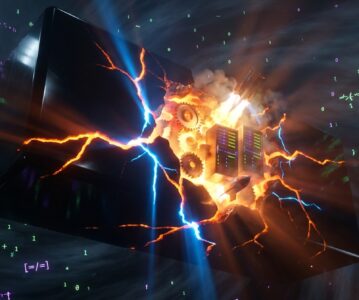
Even the minimalist black interface can’t hide the “brain” burning through hundreds of millions of dollars in computing power behind the screen.
Musk is back on X, posting that iconic “Game Over” meme again.
This time, the protagonist is Grok 3.
Looking at the adrenaline-pumping Benchmark data on Twitter, the frosted donut in my hand suddenly lost its appeal. To be honest, this wasn’t unexpected, but it is indeed a bit “scary.” If Grok 1 and 2 were merely chasing OpenAI’s tail lights, Grok 3 is like a Cybertruck strapped with rocket boosters, crashing recklessly into the first tier.
This isn’t just a chatbot update; this is a signal that the Silicon Valley compute war has entered the phase of “nuclear deterrence.”
1. A Victory for Brute Force Aesthetics? Or a Miracle of Sheer Power?
Let’s not get dizzy from the flashy marketing buzzwords. Grok 3’s core logic is actually very simple and crude, even carrying an aesthetic from the old industrial age—“With enough thrust, even a brick will fly.”
Standing behind it is the data center in Memphis known as “Colossus.” Lying there are 100,000 (or more) H100 GPUs. What is this concept? It’s like people shooting at each other with rifles, and Musk pulls out a WWII-era heavy cannon—except this time, it’s not firing shells, it’s firing Tokens.
Grok 3 doesn’t win by some exquisitely delicate, never-before-seen new algorithm architecture (at least not according to current public information); it was smashed out by piles of computing power and data scale. It demonstrates a trembling possibility: perhaps the road to AGI (Artificial General Intelligence) isn’t crowded, you just need enough graphics cards—enough to burn through the power grid.
The direct result of this “brute force aesthetic” is that its performance on math (AIME) and coding tasks makes the former hegemon, GPT-4o, instantly look a bit “aged.”
2. “Think” Mode: When AI Starts Showing Its Anxiety
That tiny “Think” button might be the key step for AI evolving from a “repeater” to a “thinker.”
What interests me most about Grok 3 isn’t how fast it is, but that it has learned to be “slow.”
The newly added “Reasoning” mode (or Think mode) is actually mimicking the human thought process. When you throw out a complex question, it no longer spits out a word instantly based on probability like before; instead, it pauses, “talks to itself,” and breaks down steps.
OpenAI’s o1 series has done this too, but the difference with Grok 3 lies in its “personality.”
If you look closely at its Chain of Thought, you’ll find it lacks some of that finely polished “artificial flavor” and has a bit more “wildness.” It even acts like a real human geek, showing a certain struggle during the thinking process. This “transparent brain circuit,” while essentially the result of reinforcement learning, gives the user the experience that—it really seems to be using its brain, not just retrieving from a database.
Moreover, thanks to xAI’s relatively loose (or “wild”) safety strategy, Grok 3’s answers lack a lot of the “As a large language model, I cannot…” preachiness. For users fed up with AI acting like a nanny, this is a fatal temptation.
3. Silicon Valley Colosseum: What Do We Have Left Besides Parameters?
On this dense report card, every percentage point increase is backed by hundreds of millions of dollars burning away.
Widen the view and look next door. Grok 3’s opponents—Claude 3.5 Sonnet (and the closely following 3.7), GPT-4.5 (rumored)—are not to be trifled with.
If we compare the AI circle to the mobile phone circle, the situation is:
- Claude is like the early Apple: elegant, precise, focusing on “writing code like writing poetry,” with logic so rigorous it’s scary.
- OpenAI is Samsung: the supply chain hegemon. Although recently criticized for “drip-feeding” updates, it has deep pockets and an invincible ecosystem.
- Grok 3 is completely the “disrupter” who doesn’t play by the rules. It doesn’t have that heavy historical baggage, nor does it care about corporate compliance restrictions. Its strategy is: I’m a little smarter than you, but I’m a hundred times more interesting.
But there is a fatal flaw here: Cost.
The inference cost for a model of Grok 3’s level is enormous. For ordinary users, spending a few dozen dollars a month for Premium is one thing, but for enterprises, whether they can afford to use Grok 3 in large-scale business operations remains a huge question mark. In comparison, Claude and GPT are clearly further ahead in model distillation and cost control.
4. “Truth” Only for the Rich?
This brings me to a slightly heavy topic.
If Grok 3 can truly solve PhD-level scientific problems and write perfect complex code as advertised, is this ability becoming a luxury good?
The establishment of the Colossus cluster is in itself a capital barrier. In the future, top-tier intelligence may only be mastered by a very few giants who own massive nuclear power plants and hundreds of thousands of GPUs. The more powerful Grok 3 becomes, the more worried I am: Are we building an “intelligence gap”?
If so, Musk’s claim of “benefiting humanity” might need a parenthetical addendum—(provided you can afford the membership fee).
5. Final Thoughts
Watching the cursor blink on the Grok 3 screen, I suddenly feel that we might be standing on the threshold of an era.
This threshold leads neither to heaven nor hell, but to an “extremely expensive chaos.”
Grok 3 is like that smartest, naughtiest, and richest bad boy in the class. You might not like his arrogance, but when he slaps a full-score test paper on your face, you have to admit: this guy actually has something.
I just hope that in this crazy compute drag race, we don’t forget to look at the scenery by the side of the road. After all, if AI calculates all the mysteries of the universe but doesn’t understand the taste of a donut, that wisdom would be a bit too lonely.
References:
