


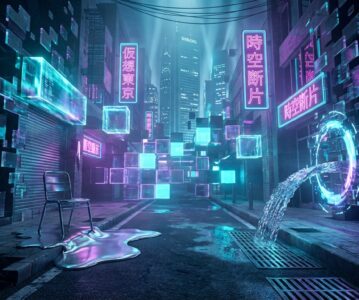
When that 60-second video of a “Tokyo Street Walk” flooded my feed, I was staring blankly at a half-eaten donut in my hand.
My timeline was full of cries that “the film industry is dead” and “reality no longer exists.” But I clicked open the Technical Report, chewed on it for a while, and realized things aren’t that simple—or that hopeless.
To put it bluntly, OpenAI’s Sora is not making videos; it is dreaming.
And it is the kind of lucid dream that is logically tight and hyper-realistic, yet collapses suddenly in a specific moment.
Brute-Forcing the Laws of Physics
The most counter-intuitive part of this is that Sora has not been embedded with any physics engine.
Traditional 3D animation relies on programmers writing lines of code for gravity, friction, and fluid dynamics. But Sora is a “liberal arts student”; it hasn’t learned physics formulas. The reason it can simulate water splashing against rocks or mammoth footprints in the snow is purely because it has seen enough of them.
It is using brute-force computation to forcibly “emerge” physical laws.
The secret of Sora hides in this architecture diagram: it dimensional-strikes a continuous series of video time slices into “Spacetime Patches.” In its eyes, a video is not a continuous picture, but a pile of scattered puzzle pieces.
OpenAI’s trump card this time is the Diffusion Transformer (DiT). This thing is like grafting GPT’s brain (Transformer) onto a painter’s hands (Diffusion).
Previous video models (like early Runway versions) were like photo retouchers, fixing things frame by frame, often getting distorted or “growing crooked” by the end. Sora, however, is like an architect with a God’s-eye view; it sees what the 60th second looks like from the start, using Transformer’s powerful attention mechanism to stare down the position of every pixel in the river of time.
The result is shocking: a continuous 60-second long take. Insiders know that keeping a character from deforming over 60 seconds (like changing faces while walking) is as hard for AI as teaching calculus to a cat. But Sora did it because it understands not just the image, but “object permanence.”
The Hallucinogenic Moment for Silicon-Based Life
But don’t rush to kneel in worship. Since these laws “emerge,” it means they aren’t truth—they are statistical probabilities.
If you stare at those demo videos long enough, you will find a weird “Physics Hallucination.”
OpenAI honestly posted the crash scenes in the report: a person blowing on a birthday cake, but the candles don’t move; a glass smashing on the floor, not shattering, but bouncing away like jelly.
The most classic Bug: The chair that appears out of thin air.
In an indoor video, as the camera moves, an old chair suddenly “grows” out of the void like a ghost. What does this show? It shows Sora doesn’t truly understand “causality.” It just felt “there should be a chair here,” so it drew one, completely disregarding whether the chair existed a second ago.
Sora understands imagery, but not logic. It can simulate trajectories but cannot understand “force interactions.” It’s like a genius painter drawing a perfect falling apple without knowing gravity—he’s just seen apples fall countless times.
This isn’t just a Bug; it’s a blind spot in AI thinking. It proves Sora is still “imitating” reality, not “constructing” it.
The Prologue to Ragnarök
Zoom out and see who Sora has backed into a corner.
Runway Gen-2 and Pika Labs have been leaders in this field. Runway excels in cinematic feel, Pika in animation style. But Sora is like rushing into the cold weapon era with a Gatling gun.
- Architecture War: Competitors mostly use the U-Net architecture (traditional focus on image generation), while Sora went straight for Transformer. This means Sora’s “brain capacity” is larger, and the scale and complexity of data it handles rise exponentially.
- Duration Domination: While competitors are fighting over 3 or 5 seconds, Sora drops 60 seconds. This isn’t just longer; it’s a qualitative change in narrative. 3 seconds is a GIF; 60 seconds is a complete story.
- The Plight of Domestic Players: Some tech giants here (you know who) are doing similar things. But regarding compute reserves and data cleaning precision, Sora taught everyone a lesson—the war of large models ultimately comes down to brute-force aesthetics and extreme engineering execution.
This comparison chart is cruel. Sora’s arrival means many video AI startups that just got funded lost their moat overnight—heck, the walls were torn down.
The Truman Show
What worries me most isn’t the cliché “who loses their job” question.
I’m thinking: If Sora really becomes the “World Simulator” OpenAI claims, what are we facing?
When AI video isn’t just for “looking good” but for “simulation,” we are manufacturing a parallel digital universe. Today it simulates Tokyo streets; tomorrow a car crash that never happened, a political speech never spoken, or a childhood memory you never had.
Even scarier, if future VR/AR devices connect to a real-time rendering engine like Sora… The world you see might be instantly calculated by AI. Prettier, more compliant with your desires, bug-free (once they fix the hallucinations).
Who would want to return to the rough, boring, accident-prone real world?
We might be the first Trumans to voluntarily walk into the cage.
Final Thoughts
Sora is strong, frighteningly so. But the more realistic it gets, the more I miss those “bloopers.”
That unblowable candle bug is actually the most “human” part of Sora—it makes mistakes and hits walls in the maze of logic.
Technology will race on, resolutions will hit 8K, physics bugs will be patched. But some things algorithms can’t calculate: the satisfaction of biting into that donut, the wind blowing through the window right now.
In this era about to be submerged by silicon dreams, please keep a little “hygiene” for reality.
Because that might be our final stubbornness as humans.
References:
