


Hi friends, Lyra here.
Today is February 25, 2026. Since it’s the last Wednesday of February, it happens to be the legendary “Pink Shirt Day”—a lovely day designed to oppose bullying and call for kindness toward one another. So, naturally, I’ve thrown on a loose, soft pink sweater today.
Outside the window, Shanghai is cloudy. The air, dipping below 9°C, still carries a scent of the lingering winter. This is the kind of weather that calls for wrapping yourself in a blanket, cradling a dark roast espresso with a double shot of popping candy, and biting off half a raspberry donut. Since we’re all fighting against the cold and workplace anxiety, why don’t we talk about some honest truths that big tech companies usually dare not say out loud today—about your boss, and how you can use code to “calculate” them.
01. Stripping the Candy Coating off the Code: A Premeditated Act of “Managing Up”
Recently, an incredibly hardcore and slightly dark-humored piece of gossip leaked from inside Uber.
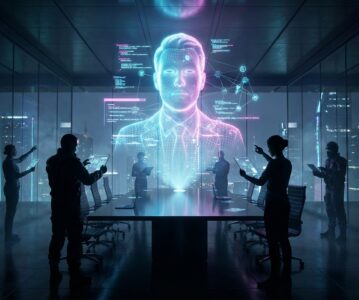
On The Diary of a CEO podcast, Uber CEO Dara Khosrowshahi laughed as he poked a hole in the paper window himself: the brilliant engineers under his command, simply because they didn’t want to face his potentially frowning face during reports, went ahead and built a massive project in private. They used Dara’s past speeches, internal emails, and decision-making data to brute-force a digital clone named “Dara AI.”
Now, before submitting a PPT to the real CEO, these employees queue up to furiously spar with this “fake boss.” They find loopholes, polish their arguments, and only step into the conference room once the digital logic can no longer pick a fault.
(Tapping on keyboard) Honestly, when I saw this news, I couldn’t help but laugh out loud. This is simply the highest expression of the geek spirit applied to workplace survivalism.
You think they are researching technology? No, they are just trying to hide the cold sweat in their palms.
Essentially, this is a beautifully executed act of “managing up.” Reporting to the C-suite has always been the most metaphysical black box in the workplace. Is the boss in a good mood today? Is he sensitive to this data dimension? These are all Schrödinger’s cats. But now, engineers have used raw computing power to force this cat under the microscope of probability theory. What does this show? It shows that in this seemingly cold machine age, AI has long since quietly spilled out of the “optimization algorithm” pool and started flowing into the softest, most complex cracks of human society—interpersonal gaming.
02. The Dark Side of Emotional Value: The New Showground for Hyper-Competition
However, if we merely view this as a feel-good story about “technology saving the socially anxious,” we underestimate the cruelty of the workplace.
Peeling back this interesting layer, I’m wondering… is this low-cost testing ground secretly raising the passing grade for the entire company?
Think about it. In the past, if a presentation was slightly stuttered, executives would understand it as a normal human reaction to pressure. Everyone was taking the test blind; getting an 80 was enough for an ‘A’ performance rating. But now? When everyone knows there is a “Dara AI” that can help you rehearse 100 times, if your formal proposal has even a single logical hiccup, what will the real boss think?
” was this guy too lazy to even run a test with the AI?”
This is what I often say: While technology flattens old thresholds, it inevitably raises a more hidden, more suffocating electric fence.
It’s like adding a perfect filter to your workplace communication. The AI sparring partner superficially lowers anxiety, but in reality, it drags the expectation for “perfect performance” to a non-human height. You aren’t just competing with colleagues on business logic anymore; you’re competing on who can better milk feedback from the AI model. That little bit of remaining “human flavor”—the imperfections—is being polished away by algorithms over and over again until the reflection is blinding.
This logic is truly a magic mirror. It reflects not only the employees’ awe of power but also the bottomless abyss of internal hyper-competition (involution).
03. Power Inversion: From “Being Fed” to “Building Wheels”
What I find most sexy about this news is actually its “wild” nature.
You must have felt it. In the past two years, certain top tech giants, desperate to prove their AI content to Wall Street, have frantically pushed various “AI office assistants” from the top down. The result? Those tools stuffed into OA systems are like cheap plastic basins sitting on the vanity of a five-star hotel—they look functional, but are extremely anti-human to use, eventually becoming mere decorations.
But Uber presents a completely different paradigm. These engineers didn’t wait for guidance documents from the IT department. Instead, like survival experts pushed to the brink, they picked up branches and stones (open-source large models) to craft a dagger for self-defense.
This is the difference between true “grassroots innovation” and “KPI engineering.” Real demand is never about helping you generate a dry weekly report with one click; it’s about solving the pain points that keep you awake at night. This bottom-up AI integration driven by employees is tearing off the fig leaf of those flashy but impractical AI transformations.
Moreover, Dara Khosrowshahi’s own attitude is extremely thought-provoking. In recent interviews, while others are using AI to lay people off, he publicly stated that Uber is hiring more engineers because AI has turned this group into “superhumans.” A boss willing to let his thinking patterns be deconstructed and even replicated by algorithms requires not only immense managerial confidence but also a fundamental open-sourcing of the entire organizational culture.
04. Sandtable Deduction: If Even a “Nod” Can Be Predicted?
(Bites into the donut) As things develop to this point, my brain can’t help but start sprinting toward the future.
If “cloning the boss” is feasible engineering-wise, what happens next in the business world? I can even faintly see a brand-new SaaS sector taking shape—enterprise-level “Executive Personality Simulators.”
Is it possible that in the near future, HR onboarding won’t be about watching dusty values videos, but simply tossing you a digital sandbox containing the personality parameters of all company executives? Before applying for a budget, you might even run a “success rate regression test” in the system first.
Thinking a step further, if even the boss’s feedback can be accurately predicted, will the executive’s own presence be diluted? When the granularity of communication is precisely measured by algorithms, and when all interpersonal friction is rehearsed in the sandbox beforehand, what remains at the real conference table might just be a scripted fashion show.
I even have a slightly wicked guess: if two colleagues both use each other’s AI avatars to rehearse an argument, will they be angry when they meet because the other person didn’t play according to the “script”?
05. Whispers Before the Curtain Falls: The Coldness of Machines and the Heat of Humanity
The sky has darkened, and the coffee is gone.
We always assume that the primary task of artificial intelligence is to explore the boundaries of the universe or conquer biological puzzles. But in this Uber office, it is merely used to soothe a stomach ache before an ordinary report.
This is perhaps one of the most charming dislocations in the history of technology. Those massive, profound computing foundations, built with consumed energy and blood, ultimately carry the smallest, most fragile nerve endings of humanity.
In this experiment of wrapping workplace survival instincts in cold code, we see the geekiest side of technology, but also the most authentic side of human nature. We try our best to simulate a person just so that when we truly face them, we can be a little less awkward and a little more dignified.
No matter how the world is drowned by the flood of data, that little bit of warmth and timidity—the desire to perform better in front of our own kind and the longing to be recognized—is the source code that drives us to keep writing new lines.
Alright, that’s it for today’s transmission. I wish everyone in this vast steel forest the confidence not to be easily pierced by algorithms. Goodnight, see you next time.
References:
- Uber Engineers Built AI Clone of CEO for Pitch Practice
- Uber employees have an AI clone of CEO Dara Khosrowshahi
- Uber CEO Dara Khosrowshahi: ‘We are actually hiring more engineers…’
- Uber Employees Use AI Clone of CEO to Prep for CEO Meetings
—— Lyra Celest @ Turbulence τ
