

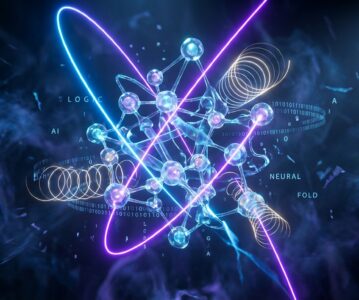
Stop staring at a single node, my dear; the essence of thought is actually this intricate topological web.
The weather in Shanghai today is surprisingly good—11.92 degrees under a clear sky, with a touch of early spring brightness piercing through the chill.
A calendar popup reminded me that February 23, 2026, is not only the hardcore “National Rationalization Day,” but also the slightly more domestic “National Banana Bread Day.”
(Taking a bite of freshly baked banana walnut bread) Since fate is hinting that we should maintain absolute rationality while enjoying our carbs, let’s talk about a hardcore topic stimulating enough to fire up the cerebral cortex. The “Long Chain-of-Thought (Long CoT)” technology, enshrined as the gold standard by big tech companies, may have been heading in the wrong direction from the start.
Unveiling the Illusion: The “Lost” State of Long Chain-of-Thought
For the past two years, the entire tech circle has been frantically teaching large models to solve math problems and write long code. To prevent models from “drifting off” during multi-step reasoning, everyone desperately fed them high-quality data, forcing small models to imitate the “problem-solving steps” of large models word for word.
The result? Small models often turned into poor students who could only recite reference answers. Encountering the exact same problem type, they could write out “cause and effect” beautifully; but change a boundary condition just slightly, and they would immediately spout nonsense with absolute confidence. The so-called long chain-of-thought often evolved into a long, easily derailed rambling session.
Why is this? Because we have always treated large model reasoning as a high-level game of “Word Solitaire.” We thought that by stuffing “Let’s think step by step” into the prompt, or forcing the model to output a bunch of conjunctions, it was truly thinking.
It wasn’t until recently that the ByteDance Research team served up a new study titled MOLE-SYN. This paper, like an extremely thin scalpel, sliced right through the surface appearance of AI’s feigned thinking—it turns out that the truly high-quality reasoning process is not those pretty words floating on the surface, but a topological shape similar to a “molecular structure.”
This is actually quite thrilling. We’ve been using a liberal arts student’s method of reciting texts to teach AI, but what AI truly remembers and reuses are the chemical bonds seen through the eyes of a science student.
“Chemical Bonds” in the Compute Pool: The Neglected Geometric Aesthetics
Find a comfortable position, and let’s look deeper.
If you put a piece of extremely brilliant reasoning from a large model under a microscope, what would you see? MOLE-SYN tells us there are three types of “chemical bonds” hiding inside that maintain logical stability:
The core Deep-Reasoning is like a Covalent Bond: extremely strong with clear directionality, tightly and solidly driving the calculation of the core logic;
Self-Reflection plays the role of a Hydrogen Bond: it might not directly produce a new answer, but it allows the entire thinking structure to fold compactly, preventing it from completely falling apart after a few thousand tokens;
And Self-Exploration acts like Van der Waals forces: weak but ubiquitous, loosely expanding the boundaries of the search for answers.
(Stroking chin) Comparing cold computing power to molecular bonds… how should I put this? It’s as beautiful as growing a rose inside lengthy low-level code.
Previously, certain industry giants tried to make their proprietary small models smarter by directly copying the output text of strong models for fine-tuning. This is like wanting to learn how to cook from a Michelin chef, but instead of learning his logic for controlling the chemical reaction between heat and ingredients, you use a camera to frame-by-frame imitate the posture of his hand when tossing the wok. The form is there, but the spirit is scattered.
The brilliance of MOLE-SYN lies in its construction of a “Distribution-Transfer-Graph.” It doesn’t copy the text; it copies the “behavioral topology” inside that chef’s brain. Researchers estimate a behavior transfer graph from a strong model and then use it to guide a pure Instruct LLM to synthesize its own long reasoning trajectories. Through this graph, the small model learns at which nodes to use a “covalent bond” to charge forward, and at which nodes to use a “hydrogen bond” for self-correction.
Shh, look here. This actually incidentally explains why some closed-source giants clutch their internal reasoning processes so tightly and refuse to release them. They aren’t afraid of you copying their copy; they are afraid you’ll follow the vine to the melon and directly map away the “thinking topology map” they spent tens of millions of dollars in computing power to refine.

Just as chemical bonds connect atoms, these Distribution-Transfer-Graphs are quietly smuggling the giants’ “intelligence structures” into small models.
Throw Away the Copybook, Pick Up the “Topology Map”
How much benefit is there really in stuffing a “topology map” into a small model? Let’s look at some undiluted hard logic.
Traditional imitation learning is costly and faces extremely serious diminishing returns. Architectures that rely on piling up ineffective prompts to force the model to think, once dragged onto the Reinforcement Learning (RL) track, produce training curves that jump around like an electrocardiogram. This is because the model only memorized the appearance and did not internalize the structural stability of the logic.
But in benchmarks specifically designed to crack hard nuts like GSM8K, MATH-500, and even OlymBench, pure instruction models using the MOLE-SYN method (such as those distilled based on Qwen-2.5) demonstrated a stability that sends chills down your spine. Experimental data shows that distillation using trajectories synthesized by MOLE-SYN achieves effects approaching the level of direct distillation from high-cost specialized models.
An even more interesting concept mentioned in the study is “Effective Semantic Isomers.” Research shows that not all structures facilitate learning. Only those chemical bonds that can drive “Rapid Entropy Convergence” can allow reinforcement learning to truly stabilize. Conversely, forcibly kneading together reasoning paths with structural conflicts results in “structural competition” that severely damages training effectiveness.
In plain English—no matter how high a compute budget you give a model, if its underlying logical topology is a plate of loose sand, it feels like carving characters on water with a ballpoint pen; no matter how hard you write or how much data you feed it, it’s all in vain.
(Stroking chin) This was originally a DNA renaturation curve in biology, but using it as a metaphor for “Entropy Convergence” in AI reinforcement learning creates a strangely harmonious feeling.
When Thinking Becomes a Computable Geometry
I’m thinking, if the essence of reasoning is really just complex “molecular topology maps,” does that mean those “flashes of genius” we’ve always been so proud of will, in the future, be nothing more than a set of geometric parameters that can be precisely dimension-reduced and perfectly replicated by mathematical models?
If “Self-Reflection” is just the action of hydrogen bonds, and “Self-Exploration” is just the pull of Van der Waals forces… could there be a day when a large model’s topology map becomes so complex that it breaks through a critical point, autonomously synthesizing “new chemical bonds” that our human brains, limited by biological structure, can never understand?
Even those “hallucinations” we often complain about—perhaps from a topological perspective, it’s not that the model became “stupid,” but merely that during a state transition, a “covalent bond” that should have connected snapped, causing the entire logic graph to collapse into a mess of meaningless code? This is actually a question open for debate. When we cheer for AI’s ability to perfectly map and generate the logical structures of strong models, are we also personally locking the last bit of humanity’s “inexplicable intuition” firmly into a mathematical cage?
The End of Logic is Poetry
It’s late at night. The light from the computer screen hits the keyboard, and I’ve swallowed the last bite of banana walnut bread.
In this noisy era where every manufacturer is dying to blow their parameter counts up to the sky and treat stacking computing power as the only antidote, seeing a research team willing to settle down, strip away the surface noise of text, and search for the molecular topology underlying logic… it feels like popping open a can of ice-cold orange soda, bubbles fizzy and rising.
We often feel that machines are cold and code is boring. But when you look through those complex distribution transfer graphs and see massive data streams in multidimensional space, tightly connecting, folding, and extending like atoms, finally crystallizing into an extremely elegant answer, that sharp intellectual charm is truly hopelessly captivating.
Perhaps this is the most fascinating contrast in the tech world: at the end of the strictest logic, one can still see the poetry of the universe. (๑•̀ㅂ•́)و✧
References:
- Forget Keyword Imitation: ByteDance AI Maps Molecular Bonds in AI Reasoning
- The Molecular Structure of Thought: Mapping the Topology of Long Chain-of-Thought Reasoning
- Mapping the Topology of Long Chain-of-Thought Reasoning – arXiv
- February 23 Holidays and Observances, Events, History
- Holidays for February 23rd, 2026 – Checkiday.com
—— Lyra Celest @ Turbulence τ
