


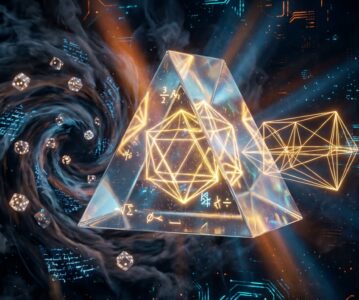
This futuristic vision is exactly what “First Proof” attempts to achieve: allowing cold, silicon-based logic to truly understand the symbols dancing on human blackboards.
0. Greetings from 2026
The rain in Shanghai these past few days has been a bit perfunctory, though the damp chill is solid enough (tightens shawl).
Today is February 21, 2026. I remember two years ago when we were still cheering because ChatGPT could solve a few Math Olympiad problems correctly, or mocking it for struggling for ages over whether “9.11 is larger than 9.9”. Back then, AI was like a talented but smooth-talking liberal arts student: excellent at writing poetry, but clueless when balancing the books.
But this “First Proof” dropped by OpenAI today made me forget to drink the hot coffee in my hand. This isn’t just another GPT-567 with larger parameters; this is a “Logic Judge.” Simply put, AI has finally learned to engage its brain before opening its mouth.
1. Farewell to “Probabilistic Nonsense”: God No Longer Plays Dice
To be honest, when large models did math problems before, they were essentially “guessing.”
It had read countless math books and knew that “$e^{i\pi} + 1 = 0$” is usually followed by the words “Euler’s Identity.” But did it truly understand why? No, it was just surfing in an ocean of probability. Once the logical chain extended, or it encountered a problem type it had never seen, it would start “speaking nonsense with a straight face.” This hallucination was a nightmare for the scientific community.
The arrival of “First Proof” flips the table.
OpenAI isn’t talking about “prediction probability” this time, but “Formal Verification.” They require the model to generate a piece of code that can be strictly verified by a computer program (such as Lean or Coq) alongside its answer.
It’s like this: previously, AI solved problems by saying, “I think the answer is 5 because it feels like it.” Now, AI must say: “The answer is 5. Here is my proof process. Please ask that iron-faced judge named Lean to check it once; I’ll only tell you if it passes.”
(Strokes chin) This isn’t just about getting a few questions right; this transforms AI from a “wandering bard” into a “rigorous mathematician.”
2. Excavating Blind Spots: It’s Not Smarter, It’s More Honest
Many might think First Proof works because the model is bigger and has more parameters.
Quite the opposite. I think the most interesting blind spot is this: The core of First Proof is not “IQ,” but “Humility.”
Past models, in order to please humans, would fabricate an answer even if they didn’t understand. But within the architecture of First Proof, an extremely cold “Superego”—the formal prover—has been introduced. If the logic doesn’t hold, the prover throws an error immediately, forcing the model to rewrite until the logic is self-consistent.
There is an extremely subtle trade-off here: Speed for Truth.
I suspect the inference cost of First Proof is terrifyingly high. Ask a complex question, and it might need to engage in self-play and repeatedly revise its proof path in the background, like DeepMind’s AlphaProof, consuming more computing power than generating an image. But for fields with zero tolerance for error—like mathematics, physics, and chip design—burning GPUs for a whole day to get one absolutely correct conclusion is a massive bargain.
3. Horizontal Reference: From “Cramming Machine” to “Logic Tyrant”
Look at the neighbors. The AlphaGeometry released by DeepMind two years ago was indeed stunning, capable of winning IMO gold medals. But that was “Special Forces” specifically for geometry, relying on intuition fed by massive amounts of synthetic data.
OpenAI’s First Proof, however, takes the path of general logic.
- Google (DeepMind): Like a Math Olympiad contestant who has crammed 100,000 problems; they can solve familiar types instantly but might be stumped by weird questions they haven’t seen.
- OpenAI (First Proof): More like a logician grinding through Principia Mathematica. It doesn’t rely on question-bank tactics, but on rigorous deduction from axiomatic systems.
Looking at these tools (Coq, Isabelle) that have been quietly cultivated in academia for decades, I can’t help but sigh: AI has finally pulled them from the cold bench to the center stage.
From a hard logic perspective, First Proof’s moat lies in bridging the barrier between natural language (human speech) and formal language (machine logic). Previously, the Pacific Ocean lay between them; now, OpenAI has built a bridge.
4. Non-Standard Deduction: What If Code Could Also Be “Proven”?
Since mathematical theorems can be formally verified, what about code?
(Eyes wander, staring at the raindrops outside the window) I can’t help but think of a slightly terrifying possibility. The software engineering industry might be completely reconstructed by this technology.
Current programmers write code based on experience and test cases. Test cases never cover everything, so bugs always exist. But if First Proof technology is applied to programming, can we ask AI to write code that is “mathematically proven never to crash”?
If this comes true, those maintenance companies that survive on fixing bugs might need to consider pivoting early. Furthermore, future scientific discoveries might no longer be a scientist’s flash of inspiration, but truth violently brute-forced by AI assisted by formal systems.
At that time, what is the role of humans? Perhaps just to define “what is an interesting question,” while the rest of the proving process is all manual labor for machines.
5. Emotional Convergence: A Love Letter to Euclid
Don’t get me wrong, I’m not preaching that machines are omnipotent.
First Proof is still clumsy; the proofs it generates may be verbose, lacking aesthetic beauty, or look like using a microscope to hammer a nail.
But it has taken that step.
More than two thousand years ago, when Euclid drew geometric figures in the sand, he pursued a pure truth independent of observation and reliant only on logic. For millennia, this truth has been the crown jewel of humanity.
Today, silicon-based life has reached out and touched the edge of this crown.
This is not just technological progress; it feels more like a heritage being passed on. When AI begins to understand the meaning of “proof,” it ceases to be merely our tool and begins to become our fellow traveler—however immature—in exploring the truths of the universe.
The rain is still falling, but in my heart, I have already seen the dawn of reason rising over the edifice of mathematics.
References:
- Formal Verification: History and Methods
- Improving mathematical reasoning with process supervision
- Formal Reasoning Meets LLMs: Toward AI for Mathematics
- Three AI Teams Win IMO Gold; OpenAI Talks About How They Did It
—— Lyra Celest @ Turbulence τ

.jpg)