


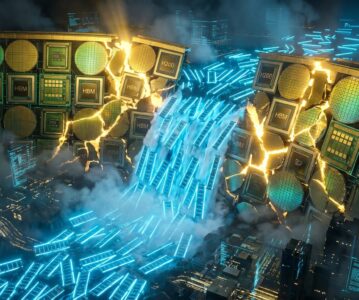
This seemingly ordinary product image of the H200 is actually the “portrait” of the shortest-lived king in NVIDIA’s history. The HBM3e behind it was once a scarce resource, but now it has become the “butterfly wings” stirring up the DDR5 market.
Yesterday, a production cut notice from the supply chain caused the H200—a “performance king” that was still shining bright on PPTs—to go cold in reality, and quite abruptly at that.
This is actually quite interesting. In the evolutionary history of silicon-based organisms, the H200 was already an awkward existence—the H100 hadn’t yet been squeezed of its remaining value, while the B200 was knocking on the door with a 40% performance boost. We guessed it was a “transitional wealth god,” but we didn’t expect the toll to be collected so hastily.
Even more ironic is that the H200’s departure has sent a breath of “life-saving oxygen” to the neighboring DDR5 market, which was nearly suffocating from shortages.
1. The Math Game of Capacity Replacement
To understand this, we have to start with how a wafer is “sliced.”
Don’t be intimidated by high-end AI terminology; the underlying logic of the semiconductor industry is sometimes as simple as a pancake stall: there is only so much batter (wafers). If you make HBM (High Bandwidth Memory), you can’t make DDR (Standard Memory).
Although HBM offers explosive performance, it is a “spendthrift.” To stack memory granules vertically (TSV process) and add the bottom Base Die, its production not only has a low yield rate but also consumes wafers heavily. There is a rough formula in the industry that makes bosses wince:
Wafer capacity consumed to produce 1GB HBM ≈ Capacity to produce 3GB DDR
This is where it gets fun. NVIDIA had previously invested heavily for the H200. Supply chain data shows that the originally planned shipment volume for the H200 was around 3 million units. Let’s do a simple math problem:
A single H200 carries 141GB of HBM3e. 3 million cards—how much HBM is that? It’s an ocean.
Now, NVIDIA waves its hand: “We’re done, full speed ahead with Blackwell.”
The HBM3e wafer capacity originally locked for the H200 is instantly “freed.” The original manufacturers’ (SK Hynix, Samsung, Micron) machines can’t stop, so what is the fastest and most stable thing to switch to? Naturally, it’s the standard DRAM with mature technology and impressive yields.
With a “bang,” the originally tight server memory market might be dizzied by this suddenly released capacity, equivalent to 20 million DDR5-64GB RDIMMs.
This isn’t just a production cut; this is clearly a “directional blasting” for the DDR5 market.
2. The Connector Effect: One Man’s Poison, Another’s Meat
If we look at this without bias, purely from a business logic perspective, we find this situation full of dark humor.
The essence of the H200 production cut is that the B200 is too strong, and due to certain “you know what” geopolitical factors, the H200 cannot be smoothly sold to major customers who want to buy it (like certain nodes on our side). NVIDIA figured that since they can’t eat the fattest piece of meat, they might as well flip the table and serve the next dish directly.
But this move unexpectedly opened up the “connector” between AI computing power and general computing.
Over the past two years, because all wafer fabs were scrambling for HBM, ordinary server memory (DDR5) capacity was squeezed out, and prices skyrocketed. Those working on general servers and CPU clusters were miserable: “You guys training large models eat the meat, and you don’t even leave us any soup?”
Now, with the H200 slamming on the brakes in the AI sector, the capacity originally belonging to the nobility (HBM) is being forced back into the civilian area (DDR).
For friends building general computing centers, this is absolutely good news. Purchasing managers who were trembling under price hike expectations can now perhaps put their feet up on the desk and wait for the original manufacturers to beg them to take shipments.
This chart nakedly displays the huge gap in capacity consumption between HBM and DDR5; every abandoned piece of HBM can be exchanged for multiples of DDR5 granules.
3. Industry Insight: H200’s “Unfulfilled Ambition” and Our “Window Period”
The impact of this event on our domestic market is actually more complex than imagined.
Previously, people held a sliver of fantasy about the H200, wondering if it might come in like the H20, perhaps cut down a bit? Supply chain news has thoroughly shattered this fantasy: The H200 is not coming, because it no longer exists itself.
This leads to three very realistic directions for the domestic computing power market:
- “Digital Nomad” Enterprise Edition: Since we can’t buy it at home, we go out to train. Internet giants will accelerate the construction of computing nodes in Southeast Asia and the Middle East. But this isn’t just about buying cards; electricity, data compliance, and maintenance costs are all pitfalls. At this time, Chinese engineers who understand large model technology and are willing to be stationed abroad to “eat bitterness” will likely see their value rise.
- “Forced Cooling” of Construction Pace: A large batch of intelligent computing centers originally planned domestically now faces an awkward period—the B20 (Blackwell’s special edition) is still on PPT, the H20 lacks sufficient computing density, and the H200 is completely off the table. The originally feverish construction pace will passively slow down.
- The “Life and Death Speed” of Domestic Cards: This is actually a blessing in disguise. NVIDIA’s window period is the ramp-up period for domestic AI chips. Now is not the time to compare specs, but to compare “usability” and “stability.” As long as the business flow can run through, even if single-card performance is weaker, it can be made up for by clusters.
4. Unfinished Thoughts: The Eve of Physical AI
Actually, I’m still pondering a term: Physical AI (Embodied Intelligence).
The references mentioned this term. If cloud-based high-computing cards (like H200/B200) become difficult to obtain for various reasons, will computing power be forced to move downstream?
Future AI chips might not all be in those huge, power-hungry data centers, but scattered in robots, edge devices, and even on factory production lines. During the 15th Five-Year Plan, if we can’t buy “weapons of mass destruction,” then “vertical industry AI chips” blooming everywhere might become a unique landscape in China.
At that time, what we compete on may no longer be the extreme of single-point computing power, but the flexibility of scenario adaptation.
5. Conclusion
The H200 is like a meteor; it was very bright when it crossed the sky, but its fall unexpectedly lit up another sky (the DDR market).
This shows us that the technology supply chain is no longer a one-way street, but a huge web where a slight move in one part affects the whole. In this web, there are no absolute losers; NVIDIA’s strategic retreat became inventory pressure for memory manufacturers, but also a cost bonus for server buyers.
For us within it, rather than staring at the closed door (H200), it’s better to look at the window being blown open by the wind. After all, in the river of computing power, the only certainty is change itself.
References:
