




The tech world’s boiling pot has been stirred up once again, this time by a “catfish” named Devin.
Cognition AI’s positioning for it is simple—“The World’s First AI Software Engineer.” Please note: not an “Assistant,” not a “Copilot,” but an “Engineer.”
This is not just an overstep in title; it is another critical condition notice served by Silicon Valley to carbon-based life forms. However, after watching all the demos and reading that controversial technical report, I have only one thing to say: Devin isn’t going to steal your rice bowl just yet, but it is dismantling the ladder you use to get in the door.
1. Deep Insight: From “Fill-in-the-Blanks” to “Word Problems”
The first reaction many people had to Devin was: “Isn’t this just GPT-4 in a wrapper?”
Wrong. Dead wrong.
Previously, when we used GitHub Copilot, it was like you were writing an essay and it was prompting you with words from the sidelines. You stop, it stops. The logical “steering wheel” remained in your hands.
Devin’s terror lies in its “Agency.”
You throw it a line: “Get this Llama model running and fix any environment errors along the way.”
It won’t ask you, “What Python version should we use?” Instead, it takes over the terminal directly, plans its own path, writes the code itself, reads the logs when it hits an error, and then fixes it on its own.
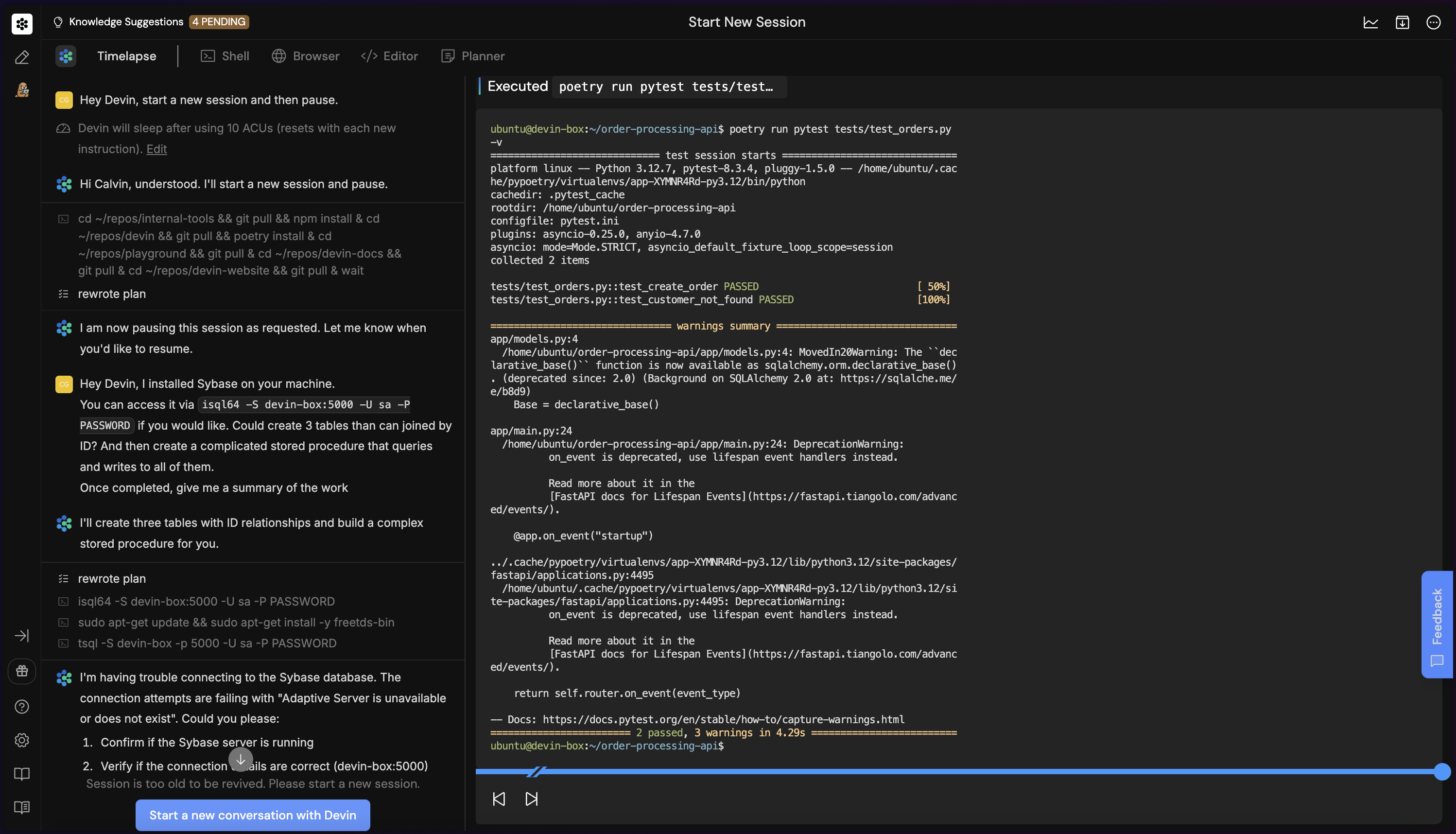
This interface image looks ordinary, but it hides a killer feature: the left side is its “thinking and planning area,” while the right side is the browser and terminal it controls autonomously. It no longer needs humans to feed it spoonful by spoonful; it has learned to “hold the spoon itself.”
This ability for “Autonomous Loop” is the fundamental reason the capital markets are going crazy over it. It is no longer a simple Large Language Model (LLM); it is a “junior outsourcing team” embedded in your IDE. It can not only write code but also read API documentation, learn new technologies, and even take orders on Upwork to earn money (although that demo was later debunked as being suspected of “embellishment,” but we’ll talk about that later).
To put it plainly, Copilot improves typing speed; Devin attempts to replace the “brain circuit.”
2. Independent Perspective: The 13.86% “Passing Line” and the Popped Bubble
Even if it’s hyped to the skies, we have to look at the hard data.
On SWE-bench, the authoritative leaderboard for measuring AI programming capabilities, Devin’s resolution rate is 13.86%.
You might laugh: “Only roughly 14 percent? Isn’t that useless?”
Hold on. Before Devin, the highest score on this list (Claude 2) was only 1.96%.
This isn’t an accumulation of quantity; it’s a mutation of species. It’s like a one-year-old human baby: although teetering when they walk, compared to the strongest chimpanzee, they have already mastered the key to bipedalism.

This chart is brutal: that tall pillar represents not “perfection,” but “usability.” In the history of AI evolution, 13.86% is the starting point of the Cambrian Explosion.
But even so, I must pour a bucket of cold water on this.
The demo videos released by Cognition have a heavy scent of “careful choreography.” Recently, developers analyzing the footage frame-by-frame found that when Devin handled certain Upwork tasks, it didn’t truly understand the requirements but relied on very specific prompt guidance, and some code files even pre-existed in the environment.
This is actually quite ironic: AI companies are teaching AI to simulate humans, but for marketing purposes, humans learned to generate “hallucinated” propaganda like AI first.
Moreover, the technology iterates at a hair-raising speed. Just shortly after Devin was released, Cosine launched the Genie model, claiming to hit 30% on SWE-bench, and another company called Blitzy shouted numbers over 80%. Devin might face a “mid-life crisis at 35” before it even has a chance to onboard.
3. Industry Comparison: The Expensive “Intern”
If you were a boss, would you hire Devin?
Currently, it’s difficult. Devin’s operating costs are extremely high. It requires long periods of Inference, constantly making mistakes, reflecting, and rewriting. This isn’t burning electricity; it’s burning US dollars.
Compared to existing tools:
* ChatGPT/Claude: Your Consultant. You ask for strategy; it gives a plan.
* Copilot/Cursor: Your Exoskeleton. You exert force; it amplifies your strength.
* Devin: An expensive and unstable Intern. You can throw miscellaneous chores at it, but you have to watch it constantly to make sure it doesn’t delete the production database.
But in business logic, Devin wins on “End-to-End.” The most expensive cost for enterprises is always communication cost. If an AI can turn a “Requirements Document” directly into a “Pull Request,” even if it runs for ten minutes in the middle, it’s cheaper than having a half-hour meeting with a programmer.
4. Unfinished Thought: The Collapse of Apprenticeship
What I worry about most is not Senior Engineers losing their jobs, but Junior Engineers disappearing.
If you look back at your career, didn’t it all start with writing simple CRUD, fixing trivial bugs, and writing test cases? These “dirty and tiring jobs” are the necessary path for human programmers to build a systemic view and accumulate intuition.
Now, Devin does all these jobs.
If companies no longer need to recruit junior engineers to do miscellaneous work, where will future senior engineers come from?
This is like if driving schools went out of business after autonomous driving became popular—who would drive race cars in the future?
We are about to face an era of “Middle Layer Vacuum.” Programming might become a pure “Architectural Art” or “Prompt Engineering.” Future programmers might look more like “Foremen,” managing a dozen AI agents like Devin, with their daily work consisting of reviewing code, approving budgets, and bearing responsibility.
5. Final Thoughts
Devin will make mistakes, will hallucinate, and might even be slapped onto the beach by a stronger model in the near future.
But Pandora’s box has been opened.
It tells us that code generation is no longer the bottleneck; “Understanding of Intent” and “Assumption of Responsibility” are.
Perhaps in a few years, what we see in Git commit records will no longer be Author: Lyra, but Generated by Devin v5, Reviewed by Lyra.
At that time, I hope we can still understand the code it wrote, rather than just helplessly clicking that green “Merge” button and praying the system doesn’t crash.
References:
* Devin AI – Wikipedia
* SWE-bench technical report – Cognition
* Devin AI vs Engine – Compare Software Engineer Tools
* Devin AI SWE-bench score comparison (Visual)
* “First AI Software Engineer” Creators Are Accused of Lying
