


We have deeply misunderstood sleep.
For a long time, whether it’s the biohackers of Silicon Valley or ordinary people wearing a smartwatch for just one night, we have treated sleep like charging a mobile phone—only caring about “how much was charged” (duration) and “how good the contact was” (deep sleep ratio).
But a group of researchers at Stanford has just slapped this perception in the face. They say: Sleep is not charging; it is an 8-hour system-wide “live health check.”
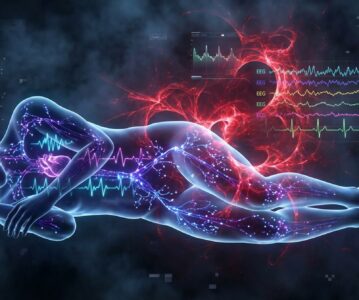
Just a few days ago, Stanford Medicine dropped a bombshell called SleepFM Clinical in Nature Medicine. This AI model does nothing but watch you sleep. Using just one night’s polysomnography (PSG) data, it can predict your risk of developing over 130 diseases.
Note that it’s not predicting whether you “slept well,” but predicting whether you will get heart failure, kidney disease, or even—cancer.
This is a bit terrifying to think about, but also somewhat exciting. Today, let’s break down exactly what fatal secrets this guy named “SleepFM” has overheard.
01. Is this “Fortune Telling” Reliable?
First, let’s talk about data—there is plenty of it.
These researchers mean business. Scouring records from 1999 to 2024, they scraped together 585,000 hours of sleep recordings from 65,000 people. This isn’t the “ballpark” data measured by the optical sensor on your wrist, but Polysomnography (PSG)—the “gold standard” of sleep medicine.
This is the difference between recording a concert with your phone (smartwatch) and a professional multi-track studio recording (PSG). PSG records brain waves, eye movements, heart rhythm, muscle tension, respiratory rate, and even blood oxygen saturation.
Previously, when doctors looked at these charts, it was like looking for typos: Is there apnea? Is there difficulty falling asleep?
But SleepFM has raised the dimension of this task. It doesn’t look for typos; it reads the full text.
It utilizes a technique called LOO-CL (Leave-One-Out Contrastive Learning) for pre-training. While the name sounds hardcore, plainly put, it trains the AI’s ability to “fill in the blanks”: cover the heartbeat data and see if it can guess the heart rhythm through breathing and brain waves; cover the brain waves and see if it can guess the brain’s state through muscle tremors.
This training gives the AI a capability similar to “synesthesia.” It no longer views the heart, brain, and lungs as independent organs, but as a precisely coupled system.
The results are astonishing.
Beyond the “easy wins” like standard sleep apnea and atrial fibrillation, SleepFM can actually predict dementia, chronic kidney disease, stroke, and even specific types of cancer.
In predicting certain cancers and circulatory system diseases, its C-index (a metric for evaluating prediction accuracy) exceeded 0.8. What does this mean? In medical statistics, anything above 0.7 is considered excellent, and 0.8 is basically being “half a prophet.”
What does this prove? It proves that before a disease grows a tumor on a CT scan or messes up indicators in your blood, it may have already quietly changed the subtle rhythm of your breathing late at night, or “frequency modulated” your heart-brain coordination patterns during deep sleep.
These tiny “butterfly wing flaps” are invisible to the naked eye of human doctors, but AI sees them clearly.
02. A “Dimensional Strike” on Smart Wearables
Reading this, you might look at the Apple Watch or Oura Ring on your hand and feel that your “health manager” suddenly isn’t so impressive.
Indeed, there is a dimensional gap between current consumer-grade devices and SleepFM.
The logic of current smartwatches is “feature extraction.” It measures heart rate variability (HRV), measures blood oxygen, and then applies a fixed formula to tell you: “Dear, you were a bit stressed last night.”
SleepFM’s logic, however, is “representation learning.” It doesn’t presuppose what is important; it goes into the ocean of data to “enlighten” itself on the patterns using Convolutional Neural Networks (CNNs) and Transformers.
But does this mean smartwatches are electronic trash? Not at all; rather, it’s a huge opportunity.

There is a detail with immense commercial value hidden in the SleepFM paper: It has extremely strong robustness to “missing data.”
Remember the “Leave-One-Out Contrastive Learning” mentioned earlier? Since this model got used to working with “one eye missing” or “one ear missing” during training, when deployed in the real world—even without the full suite of hospital sensors (perhaps only having heart rate and breathing data)—it can still provide a fairly reliable prediction through its powerful “brain filling” capability.
This points a clear path for future wearable devices: Hardware doesn’t need infinite stacking; algorithms are the ceiling.
Maybe in two years, the new generation band released by a tech giant will be running a distilled version of such “foundation models” underneath. At that time, the prompt popping up on your band won’t be “suggest going to bed early,” but “suggest booking a cardiologist appointment, probability 85%.”
03. The Sword of Damocles Hanging Over Our Heads
After geeking out on the tech, we have to talk about grim reality.
If SleepFM really becomes widespread, will the world be better? Medically, certainly. But sociologically, it’s complicated.
When “fortune telling” becomes science, who is the happiest? Insurance companies.
Imagine when applying for life insurance, the company no longer asks you to take a physical exam and draw blood, but says: “Sir, please authorize us to access your sleep data from the past week.”
SleepFM runs once and finds that although you are currently lively and kicking, your risk of developing Alzheimer’s in five years is three times that of a normal person. Then, your premium adds a zero, or you are denied coverage outright.
This is not just a privacy issue; this is the beginning of “biological fatalism.”
The current medical system is “prescribing medicine for the symptoms,” but the future logic might be “prescribing for your fate.” When algorithms determine that your “factory settings” or “current wear and tear” are destined to lead to a certain outcome, will you still be able to access equal social resources?
Furthermore, there is a more realistic bug: Death by anxiety.
Young people today already get anxious enough to lose sleep just seeing a sleep score below 80. If an App tells you: “Dear, last night’s data shows your probability of getting Parkinson’s in 10 years has risen by 2%,” I bet this person will definitely have insomnia tonight. And insomnia will further worsen the data, forming a perfect “Anxiety-Insomnia-Death Prediction” closed loop.
04. Written at the End: Respect the Night
What moves me most about this Stanford study is not the 0.8 accuracy rate, but its perspective on life.
It tells us that the body is an incredibly honest recorder. Every glass of wine you drink during the day, every late night you stay up, every moment you sulk—the body not only remembers but settles the accounts clearly in the dead of night when your consciousness is off, through the “whispers” of heartbeats and brain waves.
SleepFM is like a translator who knows a foreign language; it understands the body’s distress signals.
Hopefully, in the future, after possessing the ability to understand this language, we will do more than just predict death. We will learn how to treat this body—temporarily residing on this planet—more gently.
After all, the best way to predict the future is not to look at data, but to get a good night’s sleep tonight.
References:
* Stanford Researchers Build SleepFM Clinical: A Multimodal Sleep Foundation AI Model
* A multimodal sleep foundation model for disease prediction – Nature Medicine
* AI model uses sleep data to forecast disease years early
* Stanford’s AI Predicts Disease Risk From a Single Night of Sleep
* GitHub – zou-group/sleepfm-clinical
